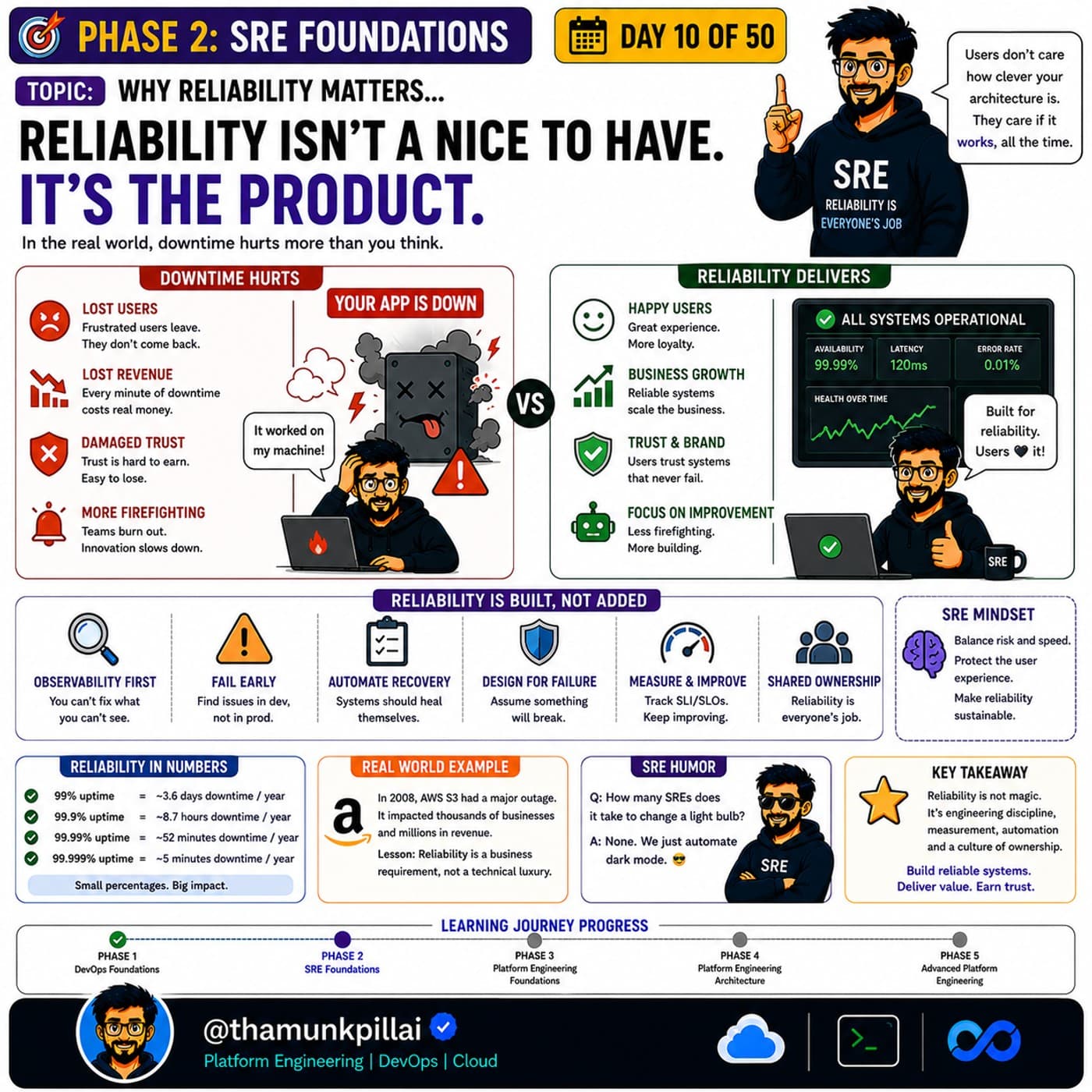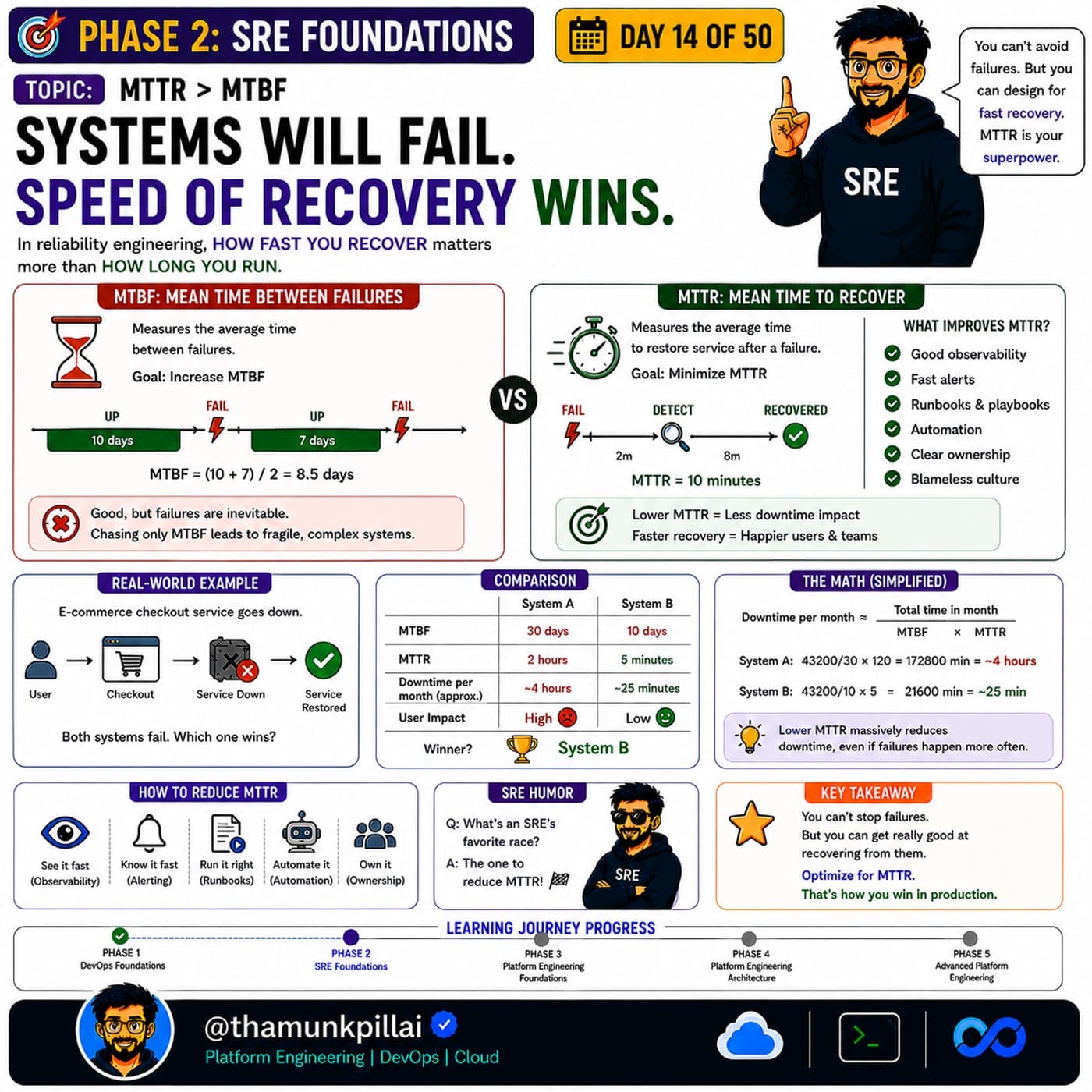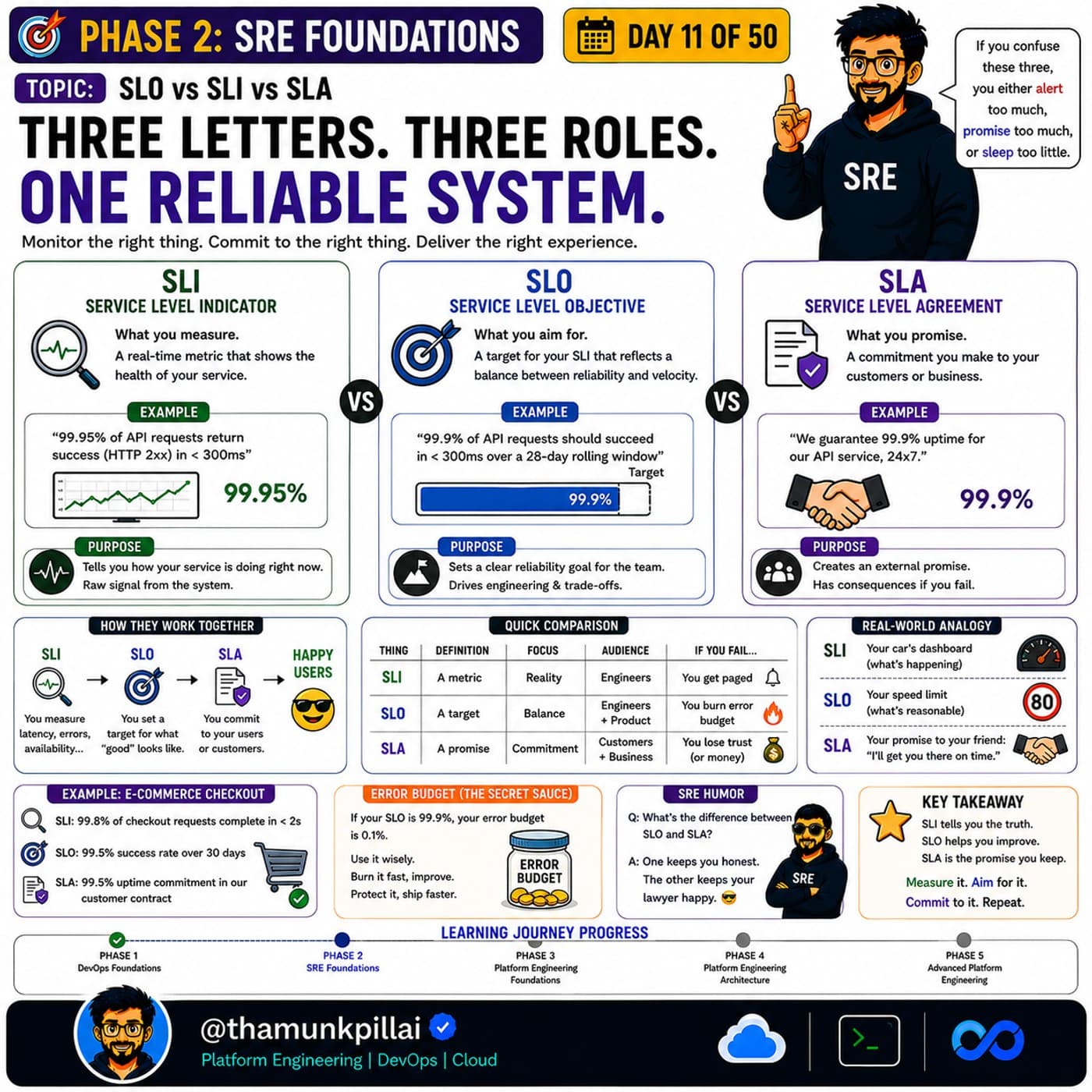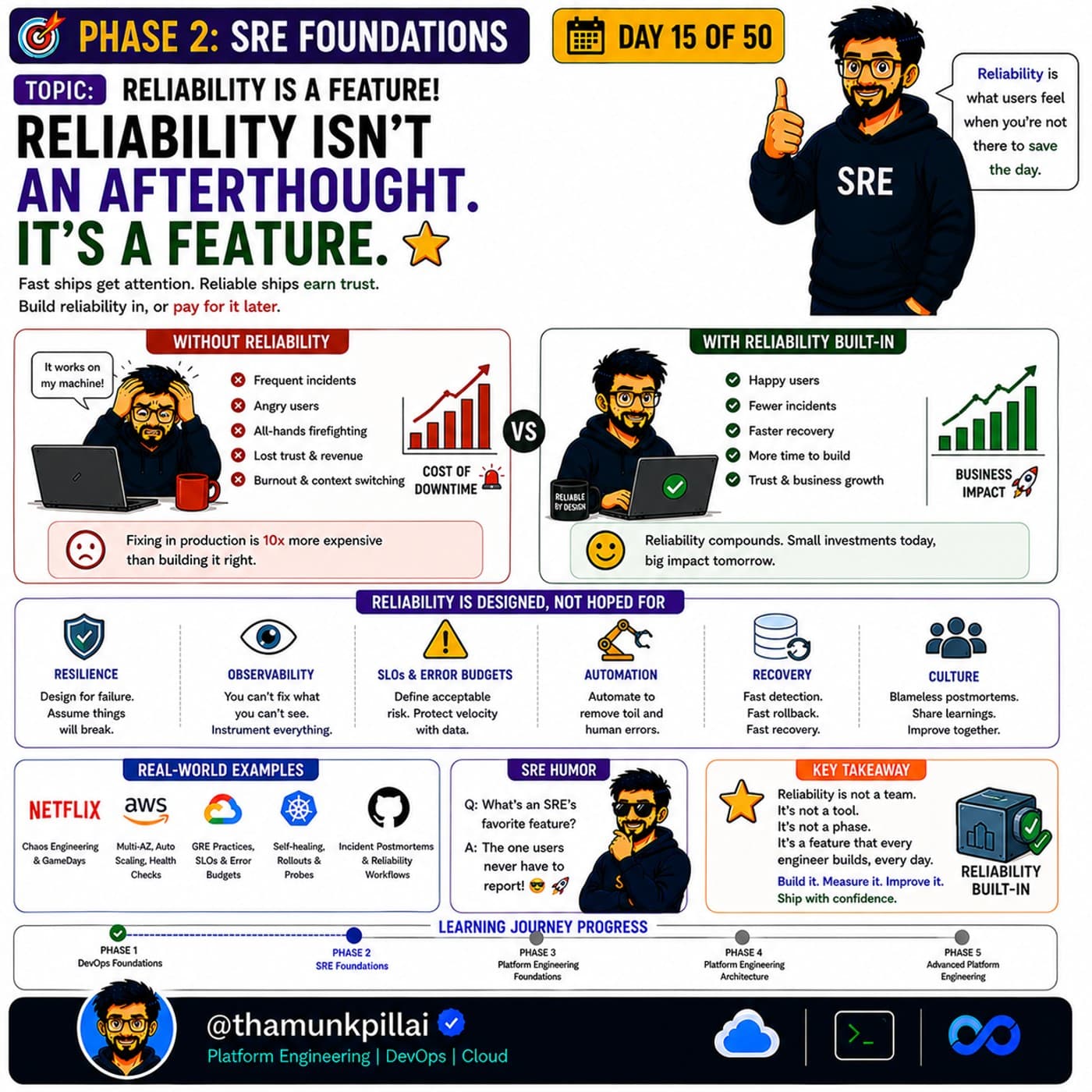
Five days ago, this series opened the SRE Foundations phase with a claim: reliability has to be engineered in, not hoped for after the fact. Everything since has been the mechanics of what that actually means in practice — SLIs, SLOs and error budgets to make reliability measurable (Day 11), toil reduction to protect the time needed to act on that measurement (Day 12), observability to see what's actually happening instead of guessing (Day 13), and MTTR as the number that matters most once failures are treated as a certainty rather than an exception (Day 14). Today is the synthesis: all five of those are different facets of one idea. Reliability is a feature, on the same footing as anything else on a roadmap — it just doesn't demo well, so it's the easiest feature to quietly deprioritize.
The list, and why it's a list of decisions, not tools
None of the five things reliability is "designed" from are exotic. They're deliberate choices, each one cheap when made early and expensive when skipped:
- Resilience — assume dependencies fail and design for it, rather than discovering the failure mode live.
- Observability — instrument before the incident, because you cannot fix what you can't see (Day 13).
- SLOs & error budgets — an explicit number for "how much unreliability is acceptable," so the team isn't relitigating risk tolerance every sprint (Day 11).
- Automation — most reliability work is removing manual steps from recovery, which is also the fastest way to cut MTTR (Day 14) and reduce toil (Day 12).
- Fast, practiced recovery — a system that fails and heals in ninety seconds behaves, from the outside, almost like a system that didn't fail.
- Blameless culture — a team that investigates why the system allowed this instead of who broke it actually fixes root causes. Tomorrow's article is entirely about this piece.
Note
Notice none of these are "buy an observability platform" or "hire an SRE team." Tools and teams can support all six — but the six themselves are engineering decisions any team can start making with what they already have. Reliability isn't gated on budget. It's gated on whether these get treated as first-class work.
The trade nobody wants to say out loud
Every one of these five practices costs something now to save more later. A retry-with-backoff is a few extra lines of code today and a saved incident during the next transient network blip. An SLO conversation is an uncomfortable hour spent agreeing on acceptable risk today, and a settled, boring answer the next time someone asks "should we ship this risky change." Skipping all of it is also cheap today — that's precisely the trap. The cost doesn't vanish, it just transfers to whoever's on call when the debt comes due, usually at the worst possible time, usually with less context than the person who could have paid it down cheaply months earlier.
Cost of building reliability in:    small, paid by the team, on a schedule
Cost of reliability debt:           large, paid by whoever's on call,
                                     at 2am, on no schedule at all
Real systems that made this bet on purpose
Netflix's Chaos Engineering practice, AWS's multi-AZ-by-default architecture, and Kubernetes' self-healing reconciliation loops aren't reliability features that got added after those systems succeeded — they're why those systems could scale to the size they did without operations collapsing under their own weight. None of them treat reliability as a phase that gets "completed." It's continuous, structural, and load-bearing for everything built on top.
The actual takeaway from this whole phase
Reliability is not a team. It's not a tool. It's not a milestone you hit and move past. It's a property every engineer contributes to on every change they ship — the same way code quality or security is everyone's job, not a gate one team owns at the end.
Where the SRE Foundations phase closes out
Two more days round out this phase before the series shifts to Platform Engineering: blameless postmortems (Day 16), which is the mechanism that turns an incident into a permanent fix instead of a monthly rerun of the same page, and incident management (Day 17), the actual operational discipline of responding well when — not if — something breaks. After that, Day 18 asks the question this whole phase has been building toward: if reliability, automation, and measurement all have to be built in from day one, who's actually responsible for making that the default every team gets, instead of something each team rediscovers independently? That's platform engineering, and it's the next 32 days of this series.