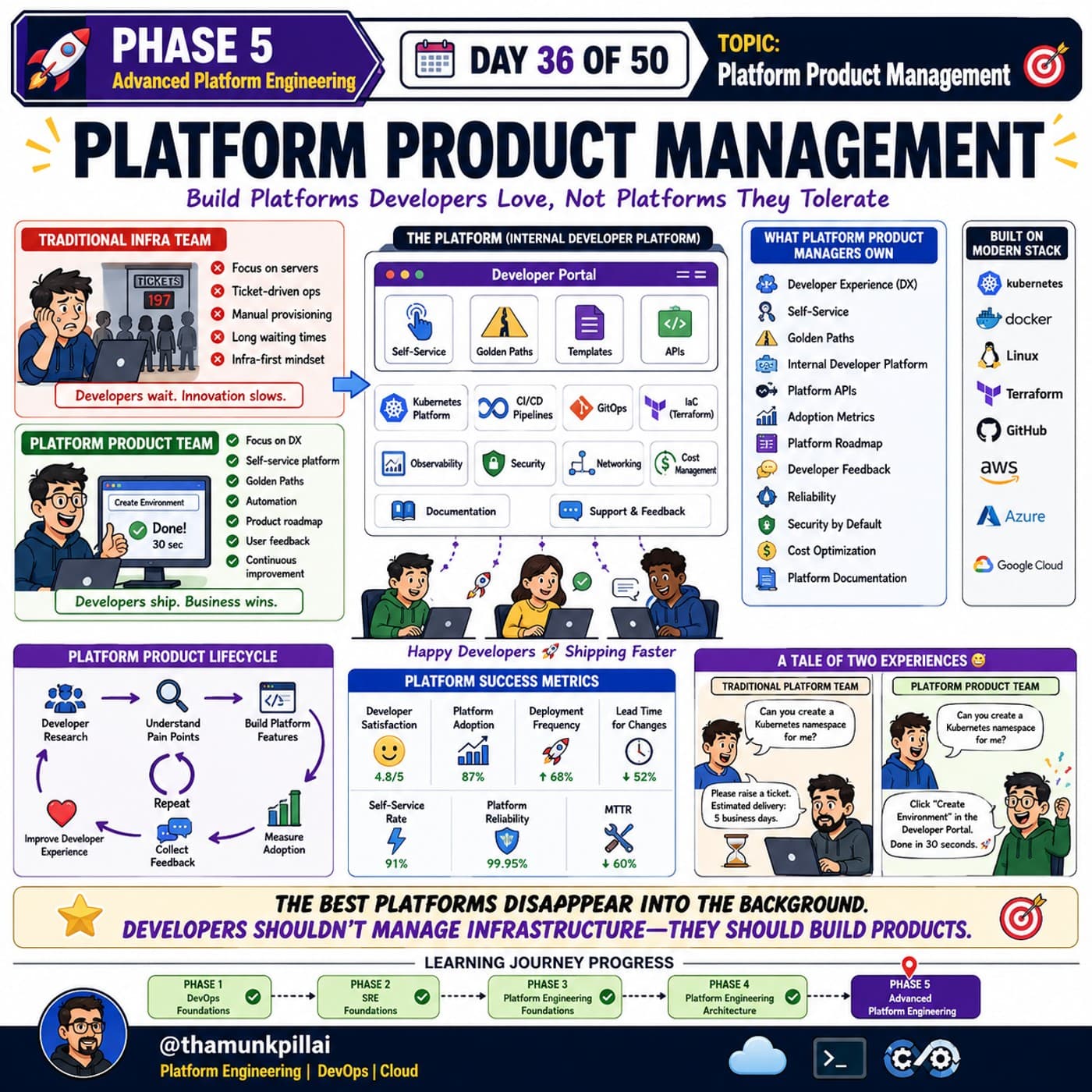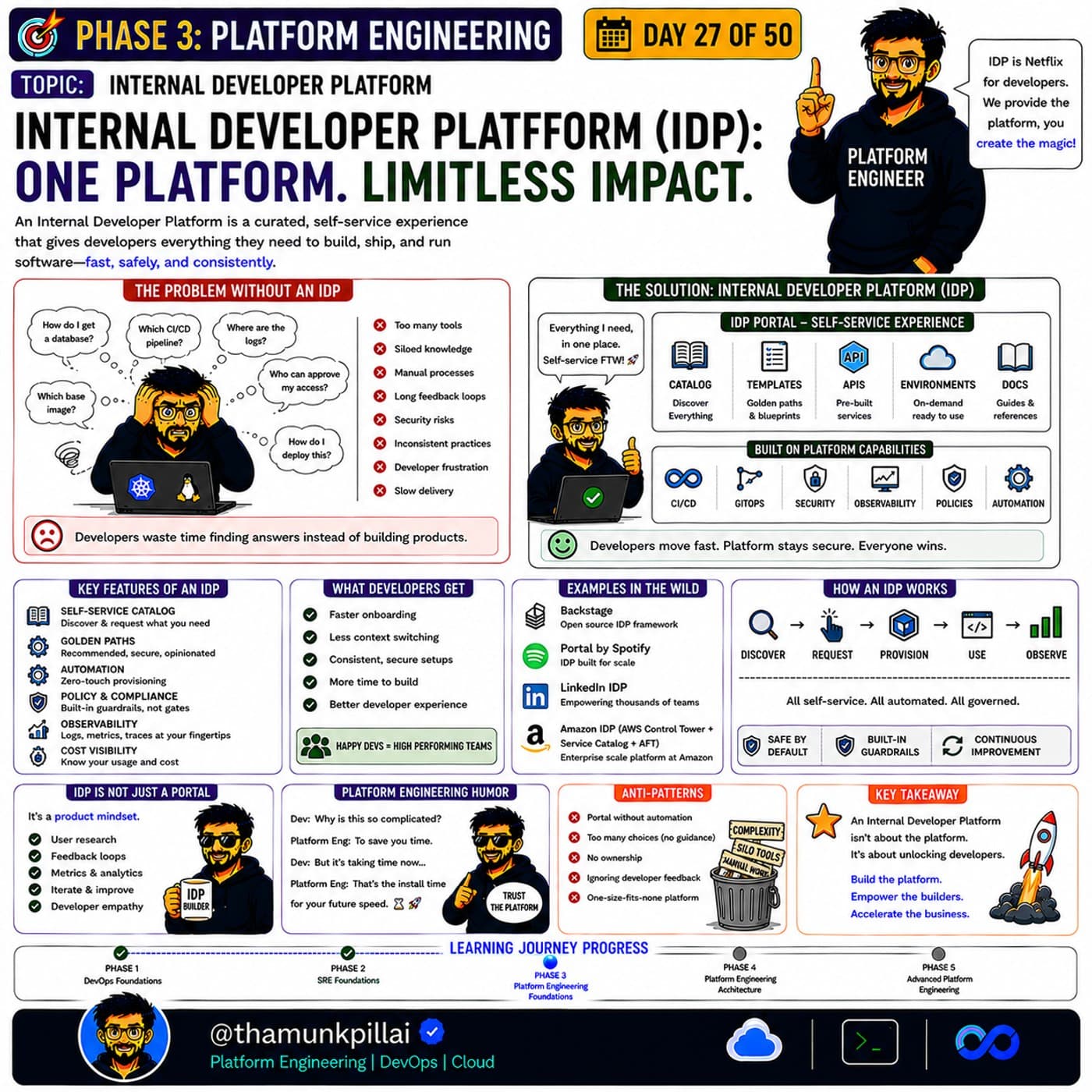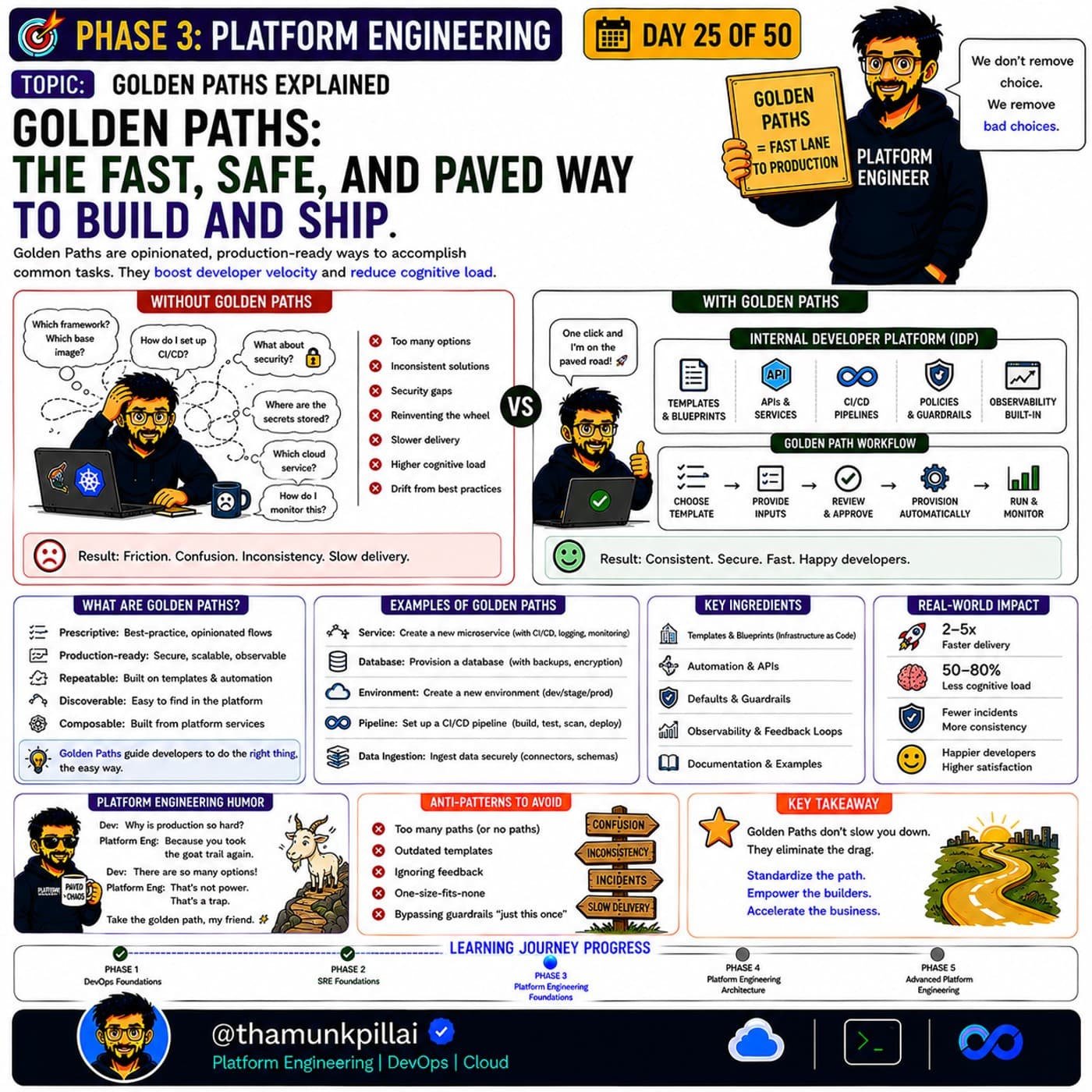
Every failure mode this series has flagged in passing — a platform built without talking to users (Day 21), a golden path too rigid to actually use (Day 25), security bolted on at the end instead of built in (Day 41) — turns out to cluster into five recurring patterns, and none of them come from platform teams being careless. They come from reasonable instincts, applied at the wrong moment or without a check against reality.
Note
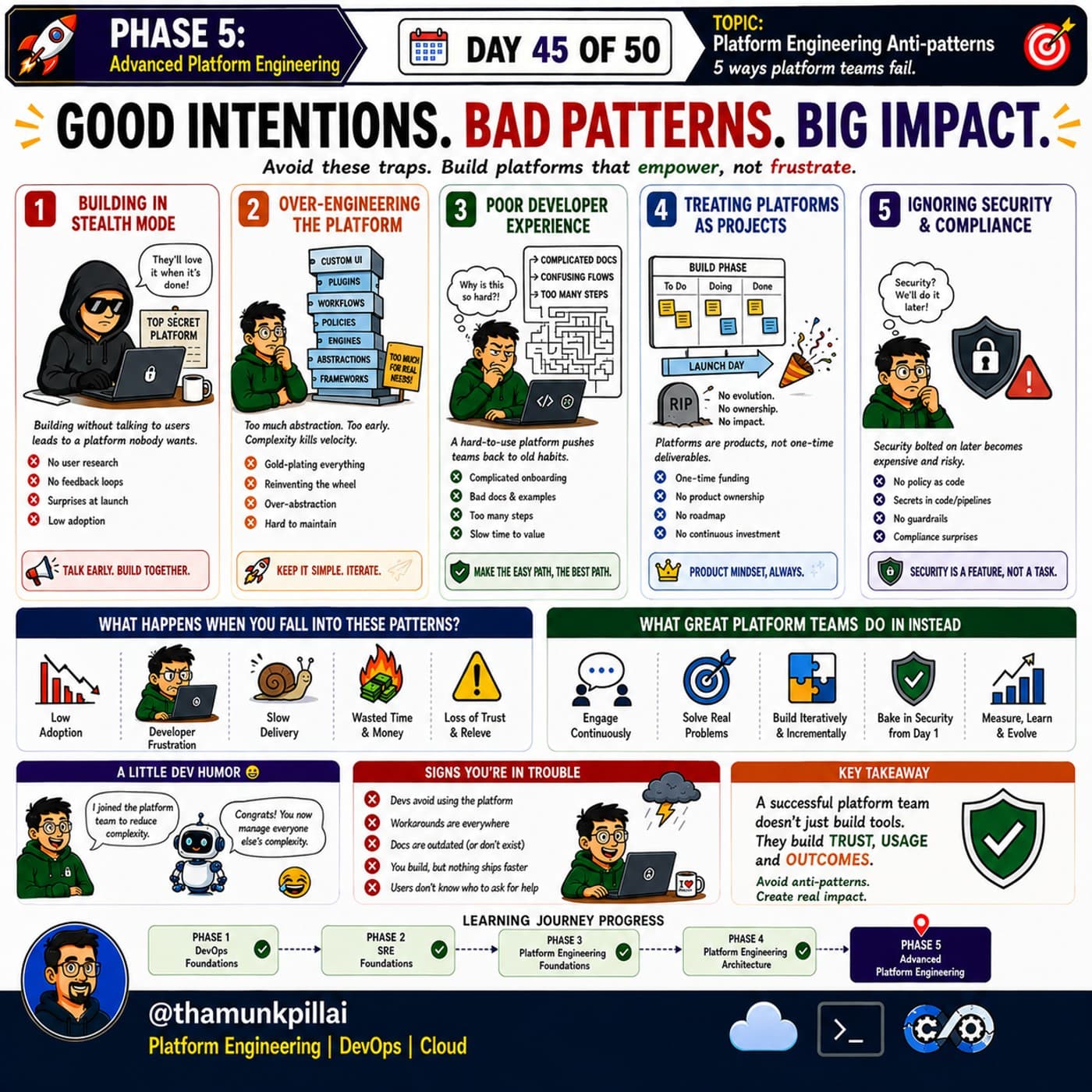
"Avoid these traps. Build platforms that empower, not frustrate" is the whole article in one line. Every pattern below starts with a defensible-sounding intention — polish before showing anyone, build it right the first time, ship on schedule — and the failure is specifically in following that instinct past the point where it stops serving developers.
The five anti-patterns
1. Building in stealth mode. "They'll love it when it's done" is the thought, and building without talking to users the entire time is the action. No user research, no feedback loops, surprises at launch, low adoption — because nobody outside the platform team validated a single assumption before it shipped. This is Day 21's "platform as a project" failure, restated as a behavior pattern rather than a mindset.
2. Over-engineering the platform. Too much abstraction, too early — gold-plating everything, reinventing the wheel, building custom UIs, plugins, workflows, policies, engines, and frameworks before a single real use case has proven any of it necessary. Complexity kills velocity, and it kills it for the platform team first, since they're the ones who now have to maintain all of it.
3. Poor developer experience. Complicated onboarding, confusing flows, too many steps, bad docs and examples. A hard-to-use platform pushes teams back to their old habits — the exact opposite of Day 22's argument that developer experience is a multiplier, not a nice-to-have.
4. Treating platforms as projects. A build phase with a "Done" column and a launch day, followed by no evolution, no ownership, no continued investment. This is Day 21's core warning, showing up again here because it's common enough to be its own named anti-pattern rather than a one-time mistake.
5. Ignoring security and compliance. "We'll do it later" — no policy as code, secrets sitting in pipelines, no guardrails, until a compliance surprise makes it everyone's emergency. Security bolted on after the fact, as Day 41 argued, is expensive and risky in exactly the way security built in from day one isn't.
What each pattern actually costs, and what good teams do instead
| Anti-pattern | What great teams do instead |
|---|---|
| Building in stealth mode | Engage continuously with real users, from day one |
| Over-engineering | Build iteratively and incrementally, starting minimal |
| Poor developer experience | Solve real problems — make the easy path the best path |
| Treating platforms as projects | Bake in a product mindset, always, with a real roadmap |
| Ignoring security & compliance | Bake in security from day one, not as an afterthought |
The signs a platform team is already in trouble
Devs avoid using the platform.
Workarounds are everywhere.
Docs are outdated (or don't exist).
You build, but nothing ships faster.
Users don't know who to ask for help.
Each of these is a lagging indicator of one of the five patterns above, and they compound: poor developer experience produces workarounds, workarounds produce outdated docs (because nobody's using the documented path to notice when it's wrong), and the whole cycle produces low adoption, developer frustration, slow delivery, wasted time and money, and — eventually — loss of trust that's far harder to rebuild than it was to avoid in the first place.
The dev-humor version, which is also the honest version
"I joined the platform team to reduce complexity." / "Congrats! You now manage everyone else's complexity." That's not really a joke about platform engineering being thankless — it's a joke about what happens when a platform team absorbs complexity without also giving it back out as simplicity for developers. Reducing your own team's complexity while increasing everyone else's isn't platform engineering; it's just moving the problem.
Why this article earns its place this late in the series
"A successful platform team doesn't just build tools. They build trust, usage, and outcomes." Every one of these five anti-patterns is survivable in isolation and often invisible in the moment — stealth mode feels like focus, over-engineering feels like rigor, treating a platform as a project feels like shipping discipline. The reason this series covers them explicitly, after forty-four days of what good platform engineering looks like, is that recognizing the failure mode in the moment is harder than recognizing it in a list. Tomorrow's article turns from what not to do to a concrete roadmap: how to actually become a platform engineer, built from the same fundamentals this series has covered from Day 1.