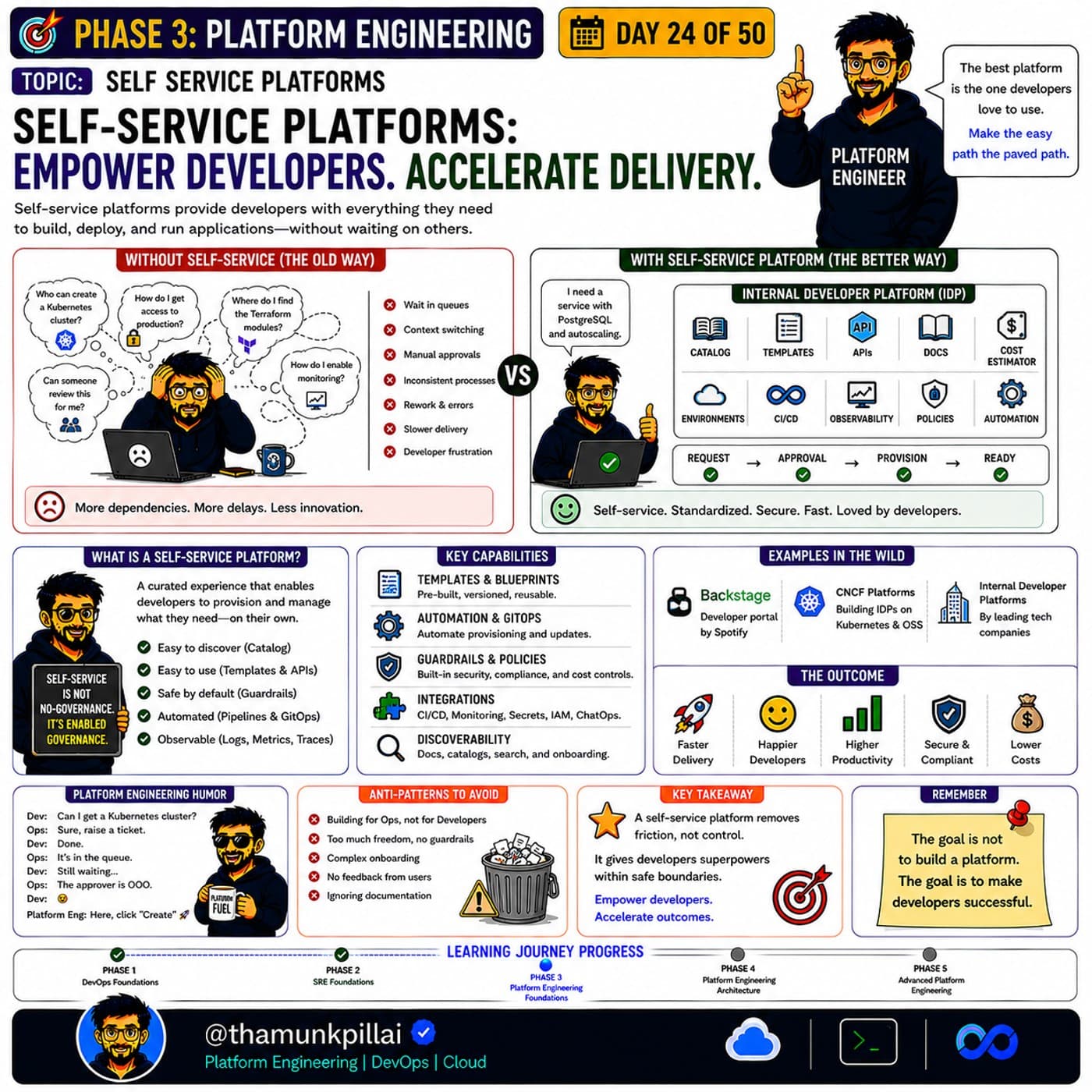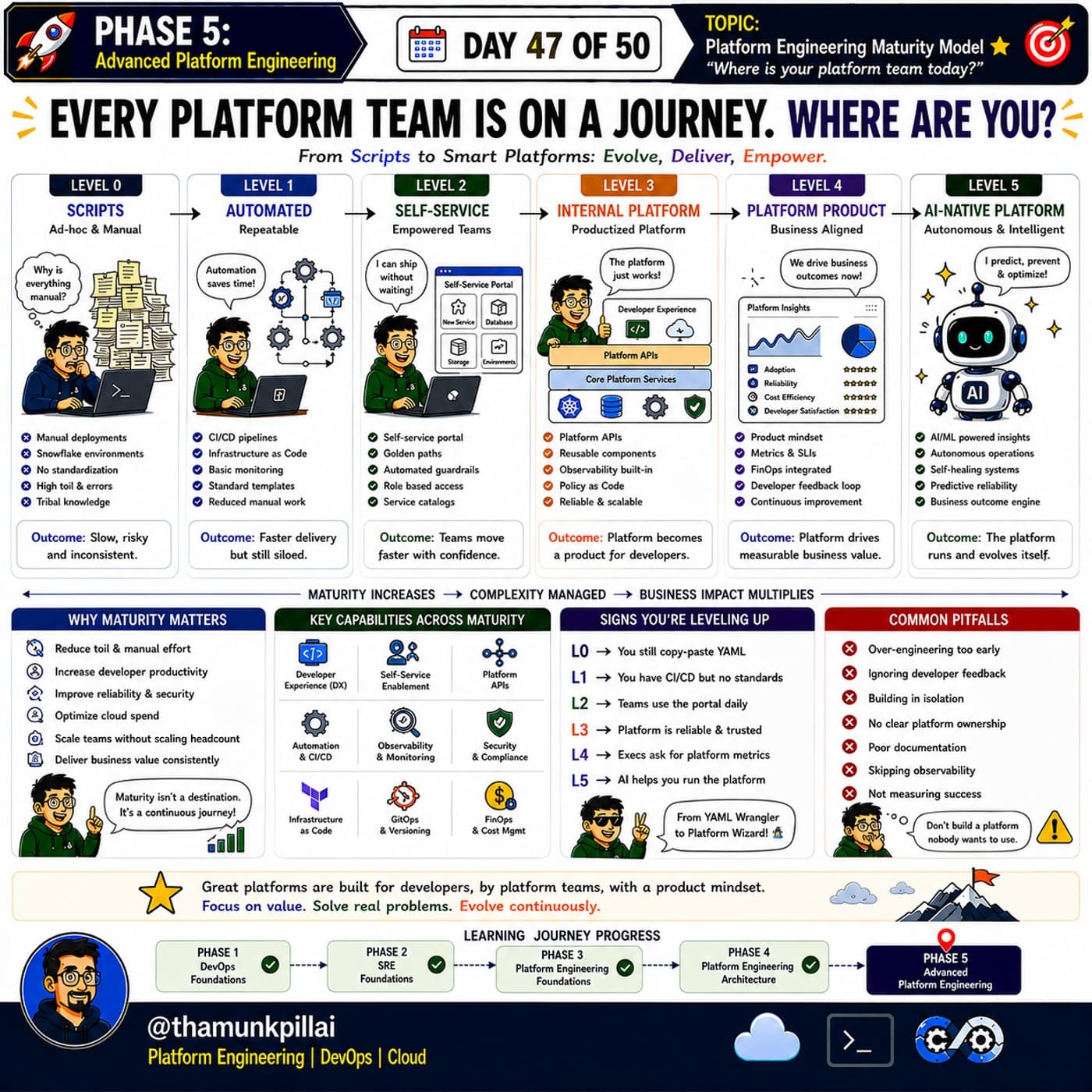
Yesterday's article put Kubernetes at the bottom of a four-layer stack and platform services in the middle. Today's article is about the layer that connects them to developers: the platform API. It's the contract — in the literal, versioned-interface sense — between "what a developer wants" and "the complex infrastructure that actually provides it." A well-designed platform API is what lets self-service (Day 24) scale past a handful of teams into hundreds, without each new team adding proportional chaos.
Note
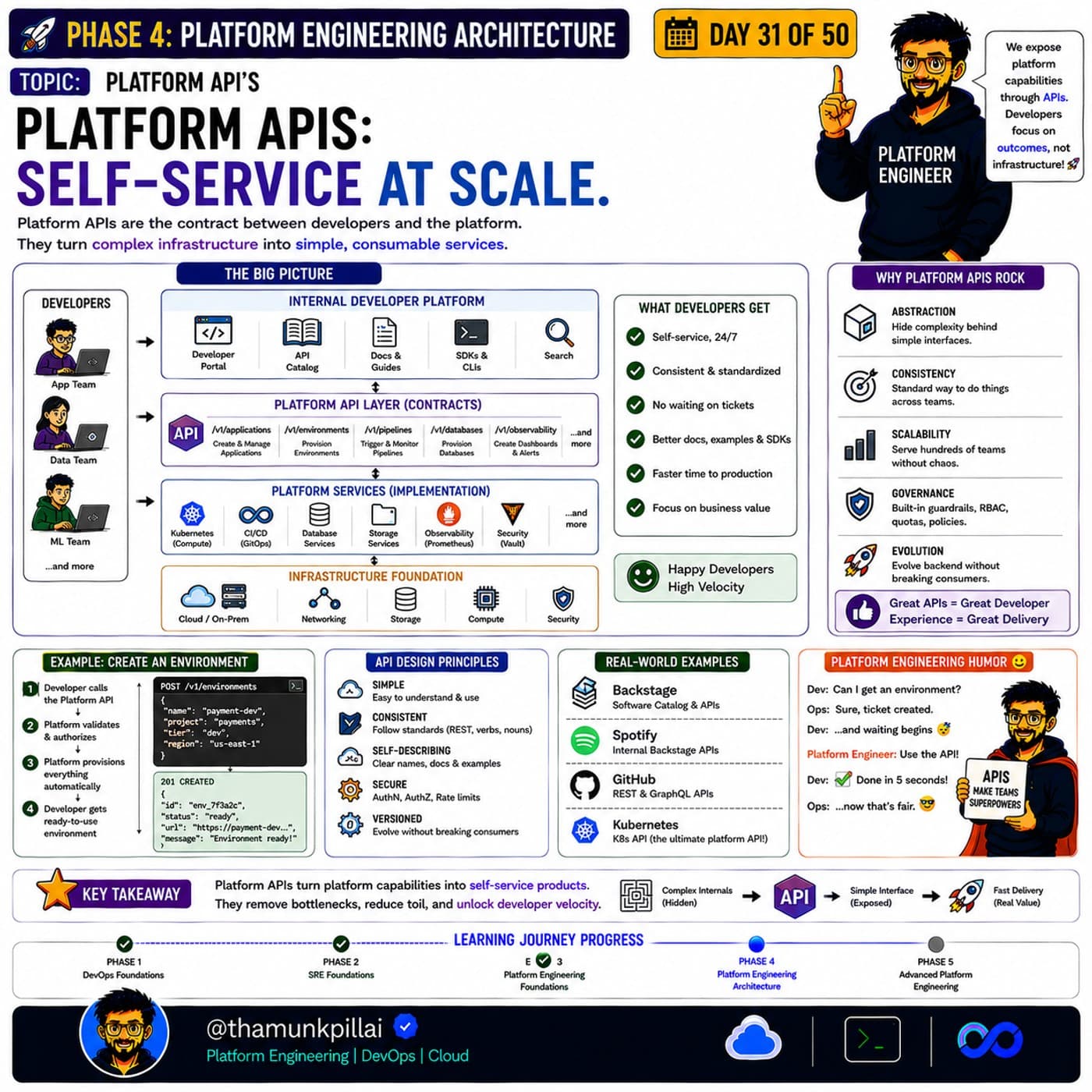
The framing worth keeping: platform APIs turn complex infrastructure into simple, consumable services. Developers call /v1/environments and get an environment. They don't need to know that call triggers a Kubernetes namespace, a set of RBAC policies, a DNS entry, and a monitoring dashboard — the API's entire job is making all of that disappear behind one clean interface.
The shape of a platform API layer
DEVELOPERS (App Team, Data Team, ML Team, ...)
      ↓
PLATFORM API LAYER (the contract)
  /v1/applications   — create & manage applications
  /v1/environments   — provision environments
  /v1/pipelines      — trigger & monitor pipelines
  /v1/databases      — provision databases
  /v1/observability  — create dashboards & alerts
      ↓
PLATFORM SERVICES (the implementation)
  Kubernetes, CI/CD (GitOps), Database Services,
  Storage Services, Observability (Prometheus), Security (Vault)
      ↓
INFRASTRUCTURE FOUNDATION
  Cloud/On-Prem, Networking, Storage, Compute, Security
The API layer is deliberately thin and stable, while everything underneath it can change. A platform team can swap the CI/CD engine, migrate cloud providers, or re-architect the database provisioning service, and as long as /v1/environments still returns the same shape of response, no developer-facing consumer needs to change anything. That stability is the entire value of treating this as a real API contract rather than a set of scripts developers happen to call directly.
What a request actually looks like
POST /v1/environments
{
  "name": "payment-dev",
  "project": "payments",
  "tier": "dev",
  "region": "us-east-1"
}

→ 201 CREATED
{
  "id": "env_7f3a2c",
  "status": "ready",
  "url": "https://payment-dev...",
  "message": "Environment ready"
}
Four fields in, a fully provisioned, guardrail-compliant environment out — no ticket, no waiting, no human reviewing the request. This is the same self-service principle from Day 24, expressed as a literal interface rather than a portal click, which matters because an API is what makes the platform programmable: a CI pipeline, a CLI tool, or another internal service can all consume it the exact same way a human clicking through a portal does.
Design principles that hold up over years, not just at launch
| Principle | What it means in practice |
|---|---|
| Simple | Easy to understand and use — a developer shouldn't need the platform team's help to read the docs |
| Consistent | Follow the same verbs, nouns, and conventions everywhere in the API |
| Self-describing | Clear names, inline docs, and examples — the API teaches itself |
| Secure | AuthN, AuthZ, and rate limits are not optional add-ons |
| Versioned | Evolve without breaking existing consumers — /v1/ exists so /v2/ can too |
The "versioned" row is the one that separates a platform API built for the long term from one that'll need a painful rewrite in two years. Every consumer of /v1/environments — CI pipelines, other internal tools, scripts developers wrote themselves — keeps working even as the platform team ships breaking improvements behind /v2/. Skip this, and every future change becomes a coordinated migration across every team that ever called the API.
Why this is the layer that determines whether self-service actually scales
Kubernetes' own API is the existence proof
The Kubernetes API itself is arguably the best-known example of this pattern working at massive scale — a stable, versioned, declarative contract that an enormous ecosystem of tools builds against without needing to understand etcd or the scheduler underneath. A good platform API applies the identical discipline one layer up, for your organization's own developers.
Without a stable API layer, self-service either doesn't scale past a handful of teams (every new consumer needs hand-holding) or scales badly (every consumer is coupled directly to implementation details that change underneath them, breaking constantly). With one, the platform team can keep improving what's underneath — swapping tools, re-architecting services, changing cloud providers — while every team building on top experiences nothing but the API staying exactly where they left it.
Tomorrow's article moves to the layer that tells you whether everything built on top of this API is actually healthy: observability for platforms, and why "you can't improve what you can't see" applies to the platform itself, not just the applications running on it.