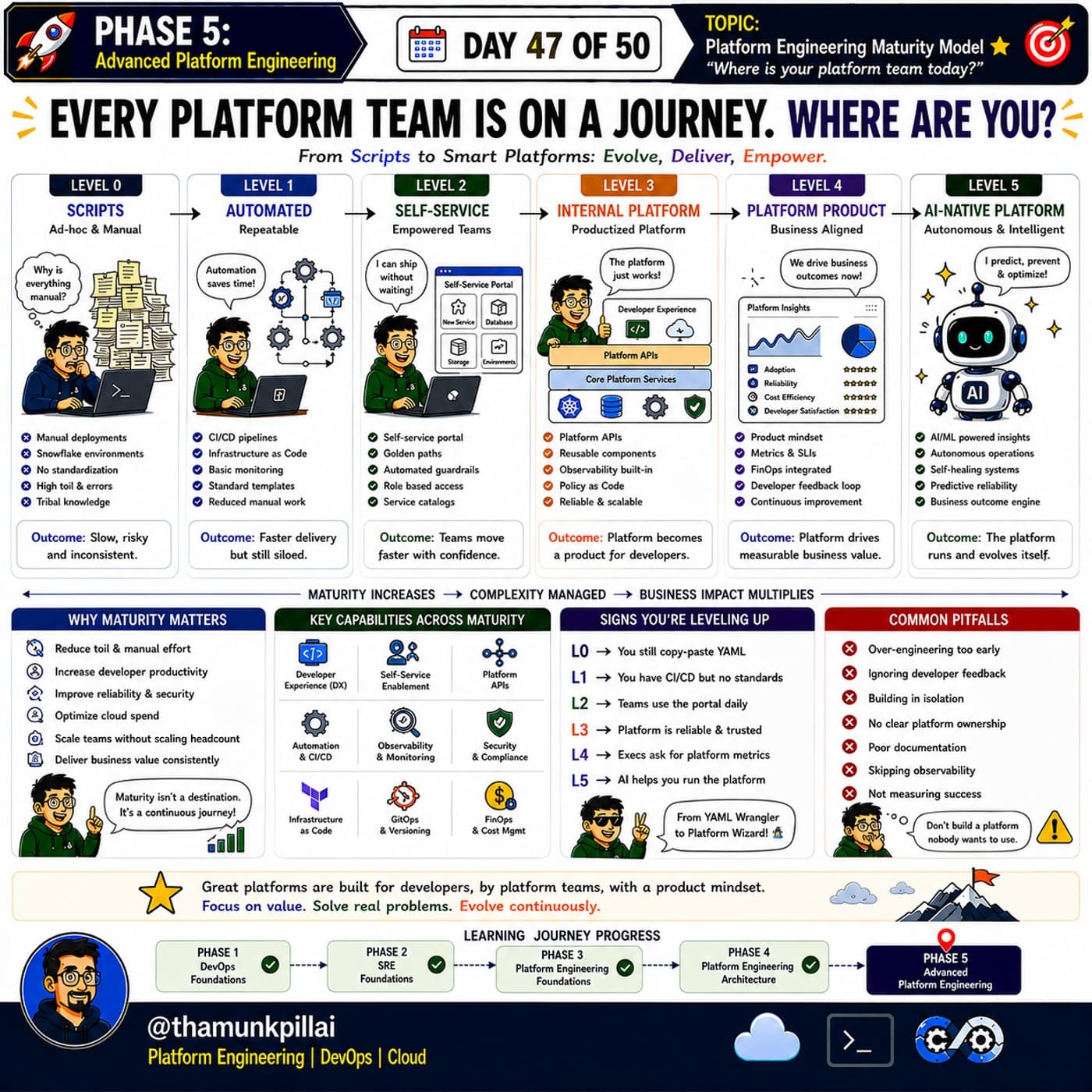
Yesterday's roadmap was about an individual's growth into platform engineering. Today's is about the platform itself — because a platform, like the engineer building it, moves through levels of maturity, and knowing which level you're actually at is the difference between a realistic roadmap and wishful thinking. "From scripts to smart platforms: evolve, deliver, empower" is the arc, and every level on it corresponds to real, previously-covered capability in this series.
Note
"Maturity isn't a destination. It's a continuous journey." No level on this model is the finish line — even Level 5 keeps evolving. The value of the model isn't reaching the top; it's having an honest, shared vocabulary for where a platform stands today, so the next investment targets the actual gap instead of whatever's most visible.
The six levels
LEVEL 0: SCRIPTS            — Ad-hoc & manual. Manual deployments, snowflake
                               environments, tribal knowledge.
LEVEL 1: AUTOMATED          — Repeatable. CI/CD pipelines, IaC, basic monitoring.
LEVEL 2: SELF-SERVICE       — Empowered teams. Self-service portal, golden paths,
                               automated guardrails.
LEVEL 3: INTERNAL PLATFORM  — Productized platform. Platform APIs, reusable
                               components, observability built in, policy as code.
LEVEL 4: PLATFORM PRODUCT   — Business aligned. Product mindset, metrics and SLIs,
                               FinOps integrated, continuous improvement.
LEVEL 5: AI-NATIVE PLATFORM — Autonomous & intelligent. AI/ML-powered insights,
                               self-healing systems, predictive reliability.
Reading this against the series so far: Level 1 is Days 5–9's infrastructure-as-code arc. Level 2 is Days 24–26's self-service and golden paths. Level 3 is Days 28–31's architecture and platform APIs. Level 4 is Days 36–40's product management, metrics, and FinOps. Level 5 is Days 33, 34, 44, and 48's AI-powered operations. The model isn't describing anything new — it's giving a name to how far through this series' own material a given platform has actually progressed.
What changes at each level, concretely
| Level | Outcome |
|---|---|
| 0 — Scripts | Slow, risky, and inconsistent |
| 1 — Automated | Faster delivery, but still siloed |
| 2 — Self-service | Teams move faster, with confidence |
| 3 — Internal platform | Platform becomes a product for developers |
| 4 — Platform product | Platform drives measurable business value |
| 5 — AI-native | The platform runs and evolves itself |
The jump from Level 3 to Level 4 is the one most platform teams underestimate, because it's not a technical jump at all — it's the Day 36 shift from "we built the platform" to "we can prove the platform is delivering business value," which requires the metrics discipline from Days 37 and 38, not new infrastructure.
Signs you're actually leveling up, versus just saying you are
L0 → You still copy-paste YAML.
L1 → You have CI/CD, but no shared standards yet.
L2 → Teams use the self-service portal daily, not occasionally.
L3 → The platform is reliable and trusted, not just available.
L4 → Executives ask for platform metrics — because they matter now.
L5 → AI helps you run the platform, not just monitor it.
The signal in each row is behavioral, not aspirational — "teams use the portal daily" is a fact you can check in usage data (Day 38), not a claim a roadmap deck can assert on its own behalf.
Warning
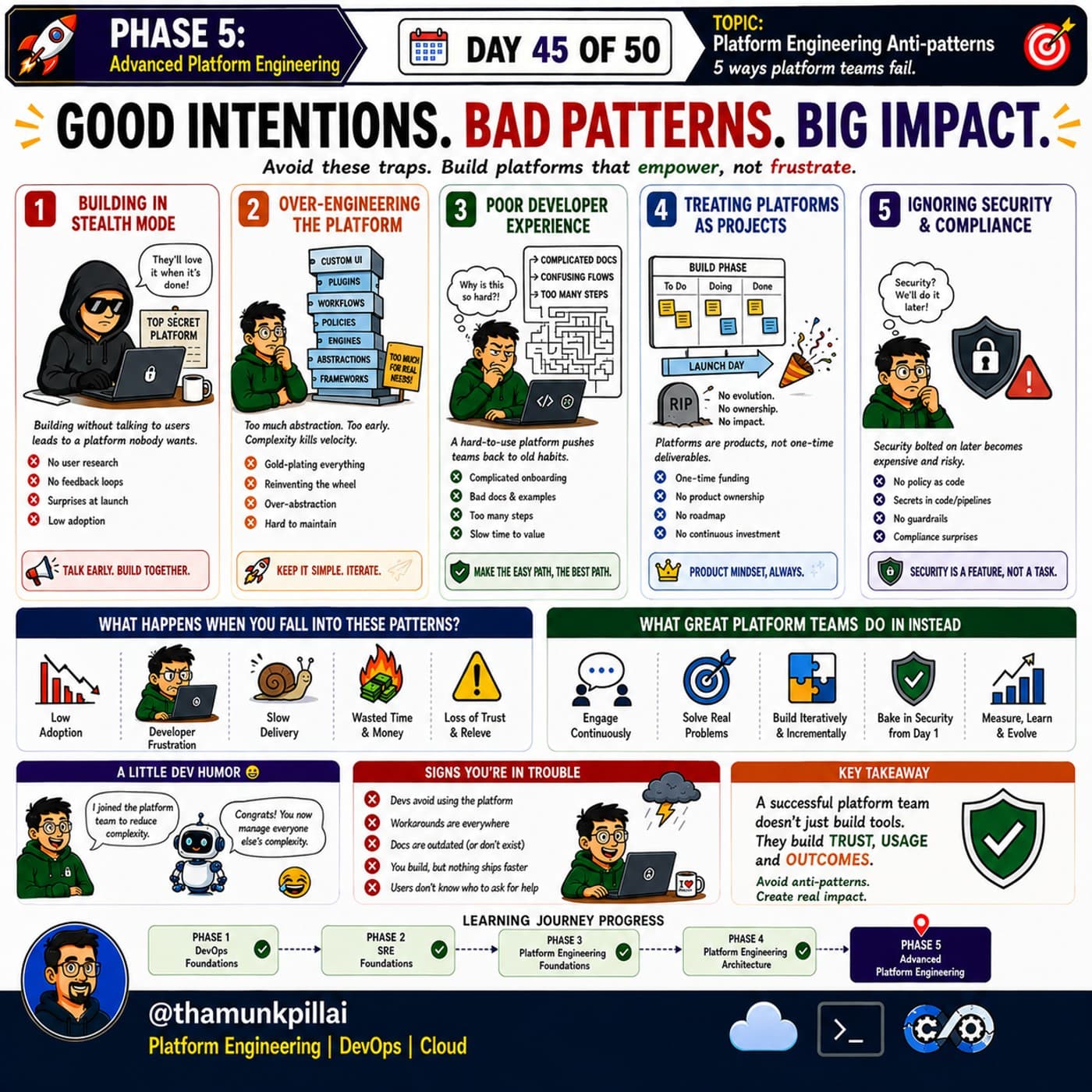
The common pitfalls at every level are the same five anti-patterns from yesterday: over-engineering too early, ignoring developer feedback, building in isolation, no clear platform ownership, poor documentation, skipping observability, not measuring success. A platform can accumulate impressive Level 3 infrastructure and still be functionally at Level 0 in outcomes, if nobody's using it — which is exactly Day 45's warning restated as a maturity-model failure mode.
Why this model is worth using honestly
"Great platforms are built for developers, by platform teams, with a product mindset. Focus on value. Solve real problems. Evolve continuously." The temptation with any maturity model is to round up — to claim Level 3 because the architecture is there, even if adoption (Level 2's actual bar) never really landed. The model only earns its usefulness if a platform team is willing to place themselves honestly, including at a lower level than they'd like, because that honest placement is what makes the next investment target the real gap instead of the comfortable one.
Tomorrow's article returns to AI agents from a different angle than Day 44 — specifically the skills and human-AI partnership model a platform team needs to work with agents safely, which is itself one of the concrete markers of reaching Level 5 on the model above.