Day 9 of this series introduced "everything as code" as a generalization of infrastructure as code — access, configuration, and policy all deserve the same discipline as servers. Security is where that argument matters most, and it's worth stating why bluntly: manual security doesn't scale, and policies drift because humans forget to check them consistently, especially the tenth time this week and especially under delivery pressure. Policy as code is the fix — write policies in code, version them in Git, validate and enforce them automatically, everywhere, all the time.
Note
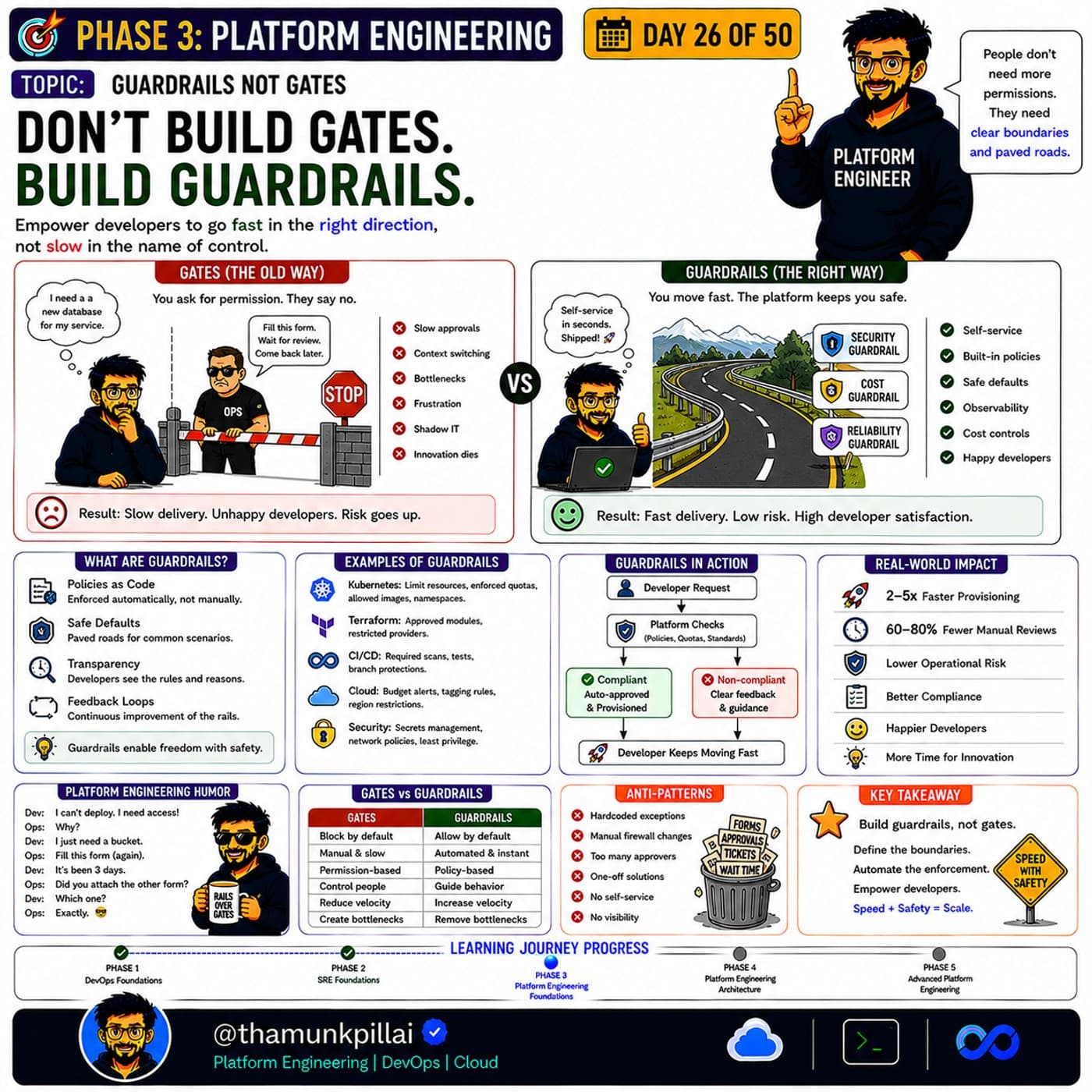
"Build guardrails once, protect everything" is the specific promise of policy as code, and it's the same guardrails-not-gates philosophy from Day 26 applied specifically to security. A guardrail written once and enforced automatically doesn't get tired, doesn't get talked out of an exception under deadline pressure, and doesn't vary depending on who's reviewing.
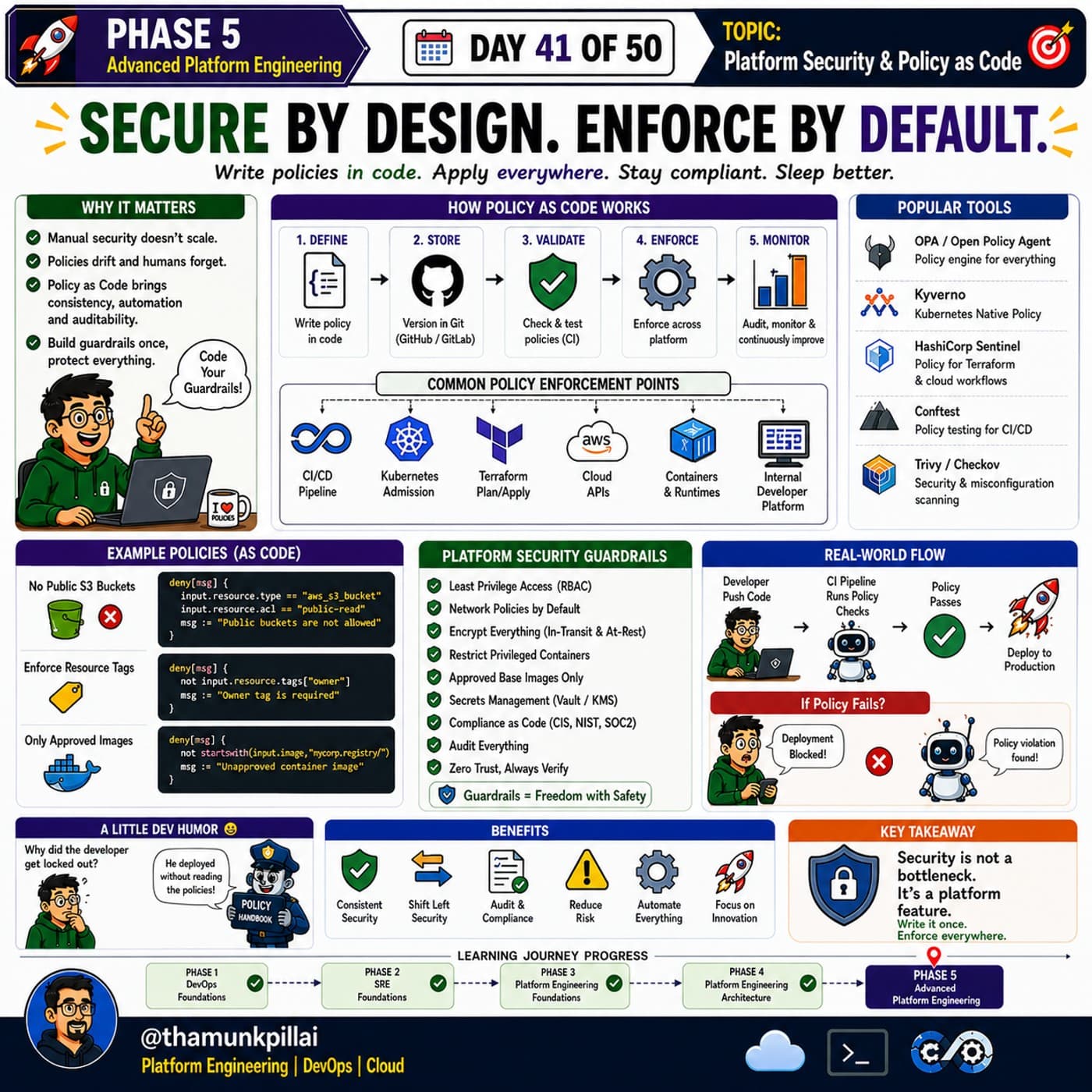
How policy as code actually works
1. DEFINE   → write the policy in code
2. STORE    → version it in Git (GitHub/GitLab), reviewed like any change
3. VALIDATE → check and test the policy in CI
4. ENFORCE  → apply it automatically across the platform
5. MONITOR  → audit, monitor, and continuously improve
This is the identical five-step shape as Day 9's everything-as-code argument and Day 32's observability loop, applied to security specifically: define once, store as a reviewable artifact, validate continuously, enforce without a human in the loop, and monitor to catch what enforcement missed. A policy that only exists in step 1 — a written rule with no automated enforcement — is a wiki page, not policy as code.
Real policy, not a hypothetical
# No public S3 buckets
deny[msg] {
  input.resource.type == "aws_s3_bucket"
  input.resource.acl == "public-read"
  msg := "Public buckets are not allowed"
}

# Every resource needs an owner tag
deny[msg] {
  not input.resource.tags["owner"]
  msg := "Owner tag is required"
}

# Only approved base images
deny[msg] {
  not startswith(input.image, "mycorp.registry/")
  msg := "Unapproved container image"
}
Each rule here is small, specific, and testable in isolation — which is exactly why policy as code scales better than a security review checklist. A reviewer manually checking twenty pull requests a day for public buckets will eventually miss one. A rule like the first one above never does, because it isn't tired at 4pm on a Friday.
Where these policies actually get enforced
| Enforcement point | What it catches |
|---|---|
| CI/CD pipeline | Policy violations before code ever merges |
| Kubernetes admission | Non-compliant workloads before they run |
| Terraform plan/apply | Insecure infrastructure before it's provisioned |
| Cloud APIs | Direct console changes that bypass code entirely |
| Containers & runtimes | Unapproved images or privilege escalation at runtime |
| Internal Developer Platform | Requests that violate policy, rejected at the self-service layer itself |
Spreading enforcement across every layer matters because any single enforcement point can be bypassed by whoever has direct access to a layer beneath it — a Terraform check doesn't catch someone clicking a change directly in the cloud console. This is the same drift problem Day 6 raised about infrastructure as code generally, now solved the same way: reconciling policy at every layer where a change could actually happen, not just the one layer most changes are expected to go through.
What a compliant flow actually looks like end to end
Developer pushes code
      ↓
CI pipeline runs policy checks
      ↓
   ┌──────┴──────┐
 Pass              Fail
   ↓                ↓
Deploy to      Deployment blocked,
production     specific violation reported
Popular tools, real stack
OPA (Open Policy Agent) as the general-purpose engine, Kyverno for Kubernetes-native policy, HashiCorp Sentinel for Terraform and cloud workflows, Conftest for testing policies in CI, Trivy and Checkov for security and misconfiguration scanning. None of this is exotic — it's the concrete tooling behind every "guardrail" this series has referenced abstractly since Day 26.
The takeaway, and how it connects everything since Day 9
"Security is not a bottleneck. It's a platform feature. Write it once. Enforce everywhere." That's the same claim Day 26 made about guardrails generally, and Day 9 made about everything-as-code generally, now made specifically about security: the choice was never between fast and secure. It was between manual security that's slow and inconsistent, and automated security that's fast and consistent — and policy as code is what makes the second option real rather than aspirational.
Tomorrow's article moves from securing one platform to a harder version of the same problem: multi-cloud platform engineering, and what it takes to keep policy, identity, and observability consistent when the infrastructure underneath spans more than one cloud provider.