The last three days of this series described AI systems that detect anomalies, correlate root causes, and recommend runbooks. None of that works if the AI can only see what a human manually pastes into a chat window. The Model Context Protocol — MCP — is the specific, concrete answer to how an AI system actually gets live access to Kubernetes clusters, GitHub repos, Terraform state, and observability dashboards, instead of operating on whatever context happened to make it into the conversation.
Note
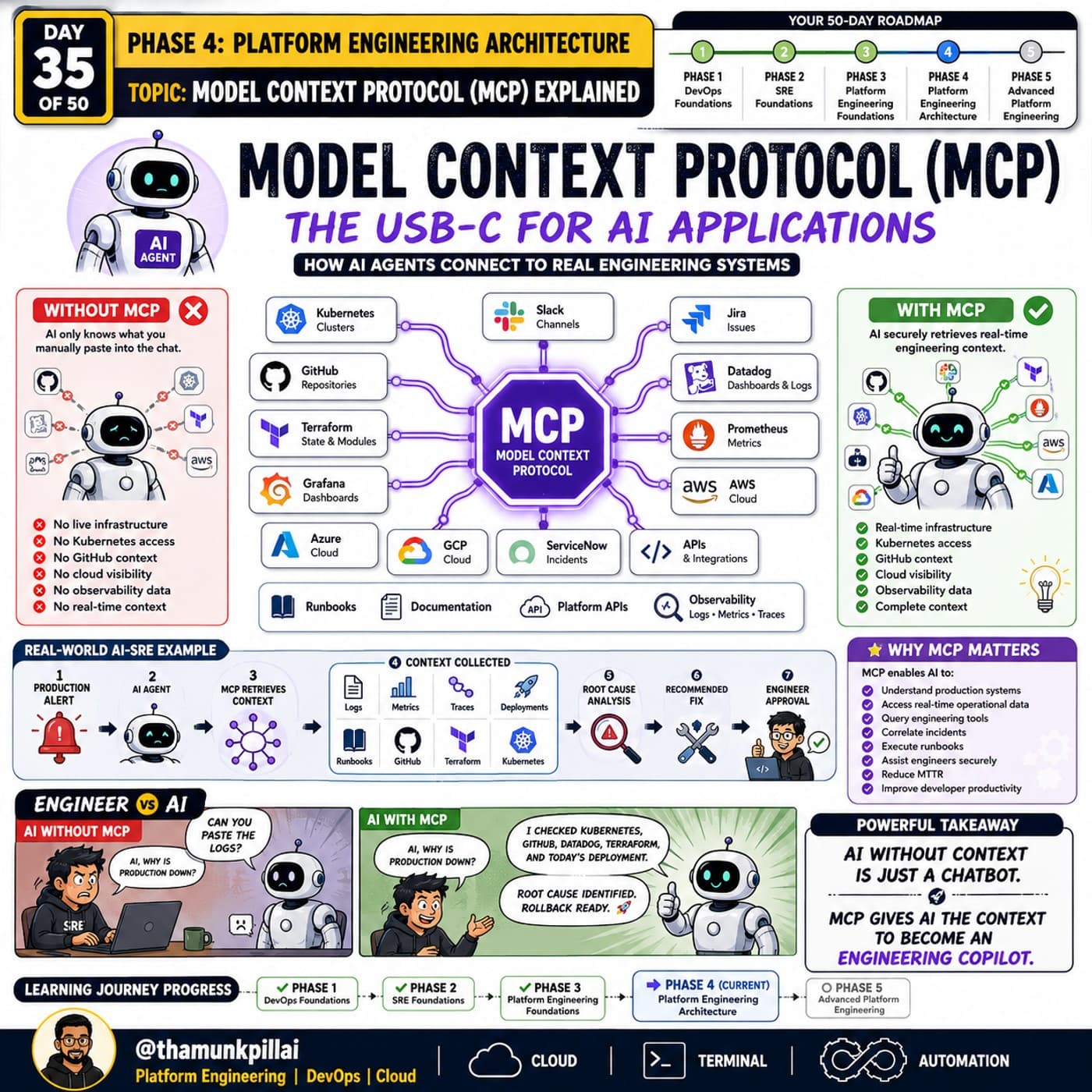
The comparison the protocol is named for is apt: MCP is the USB-C for AI applications. Before USB-C, every device needed its own proprietary connector; every AI-to-tool integration used to mean a bespoke, one-off plugin. MCP standardizes the connector once, so any MCP-compatible AI system can talk to any MCP-compatible tool without a custom integration for each pair.
Without it versus with it
WITHOUT MCP                          WITH MCP
AI only knows what you               AI securely retrieves
manually paste into the chat.        real-time engineering context.

✗ No live infrastructure             ✓ Real-time infrastructure
✗ No Kubernetes access               ✓ Kubernetes access
✗ No GitHub context                  ✓ GitHub context
✗ No cloud visibility                ✓ Cloud visibility
✗ No observability data              ✓ Observability data
✗ No real-time context               ✓ Complete context
The left column isn't a hypothetical worst case — it's the default state of any AI chat interface with no tool access: genuinely useful for reasoning about a problem, and completely blind to the actual system the problem is happening in. Every one of those checkmarks on the right requires a live, authenticated connection into a real system, which is exactly what MCP standardizes.
What sits at the hub
                Slack Channels        Jira Issues
GitHub Repos  ↘                              ↙  Datadog Dashboards
                    ┌───────────┐
Terraform State →   │    MCP    │  ← Prometheus Metrics
                    └───────────┘
Grafana Dashboards ↗      |        ↖ AWS Cloud
                          |
      Azure Cloud    GCP Cloud   ServiceNow Incidents

Also: Runbooks, Documentation, Platform APIs, Observability (Logs/Metrics/Traces)
Every spoke on that diagram is a system this series has already covered — GitHub and CI/CD from the DevOps foundations phase, Terraform from the IaC days, Kubernetes from Day 30, observability from Day 32. MCP's contribution isn't any one of those integrations; it's that an AI agent can reach all of them through one consistent protocol, rather than needing a bespoke plugin engineered separately for each one.
A concrete before-and-after for an actual incident
Without MCP:
  Engineer: "AI, why is production down?"
  AI: "Can you paste the logs?"
  (Engineer manually gathers logs, metrics, deploy history, pastes all of it)

With MCP:
  Engineer: "AI, why is production down?"
  AI: "I checked Kubernetes, GitHub, Datadog, and Terraform,
       and today's deployment. Root cause identified. Rollback ready."
The difference isn't the AI getting smarter between those two examples — it's the AI having direct, live access to exactly the systems Day 34's AI-SRE agent layer needs to correlate a root cause, instead of depending on a human to manually assemble and paste that context first, which is often slower than just doing the investigation manually.
Why MCP matters, stated plainly
MCP enables AI to understand production systems, access real-time operational data, query engineering tools directly, correlate incidents across systems, execute runbooks, and do all of it securely — with the access controls and audit trail any of this needs to be trustworthy in a real production environment. Security isn't an afterthought bolted onto the protocol; it's what makes giving an AI system this much reach defensible at all.
The key takeaway, and where this series goes next
"AI without context is just a chatbot. MCP gives AI the context to become an engineering copilot." That's the precise distinction this article has been building toward: everything Days 33 and 34 described — anomaly detection, root cause analysis, automated remediation — is only as good as the context feeding it, and MCP is the standardized mechanism for that context to be real, live, and current rather than whatever an engineer remembered to paste in.
This also closes out the run of AI-focused days in this series' Architecture phase. The remaining days move to the platform capabilities and organizational practices that make everything built so far — Kubernetes, platform APIs, observability, AI-assisted operations — actually adoptable and sustainable across an organization, starting with the practices around measuring whether any of it is actually working.