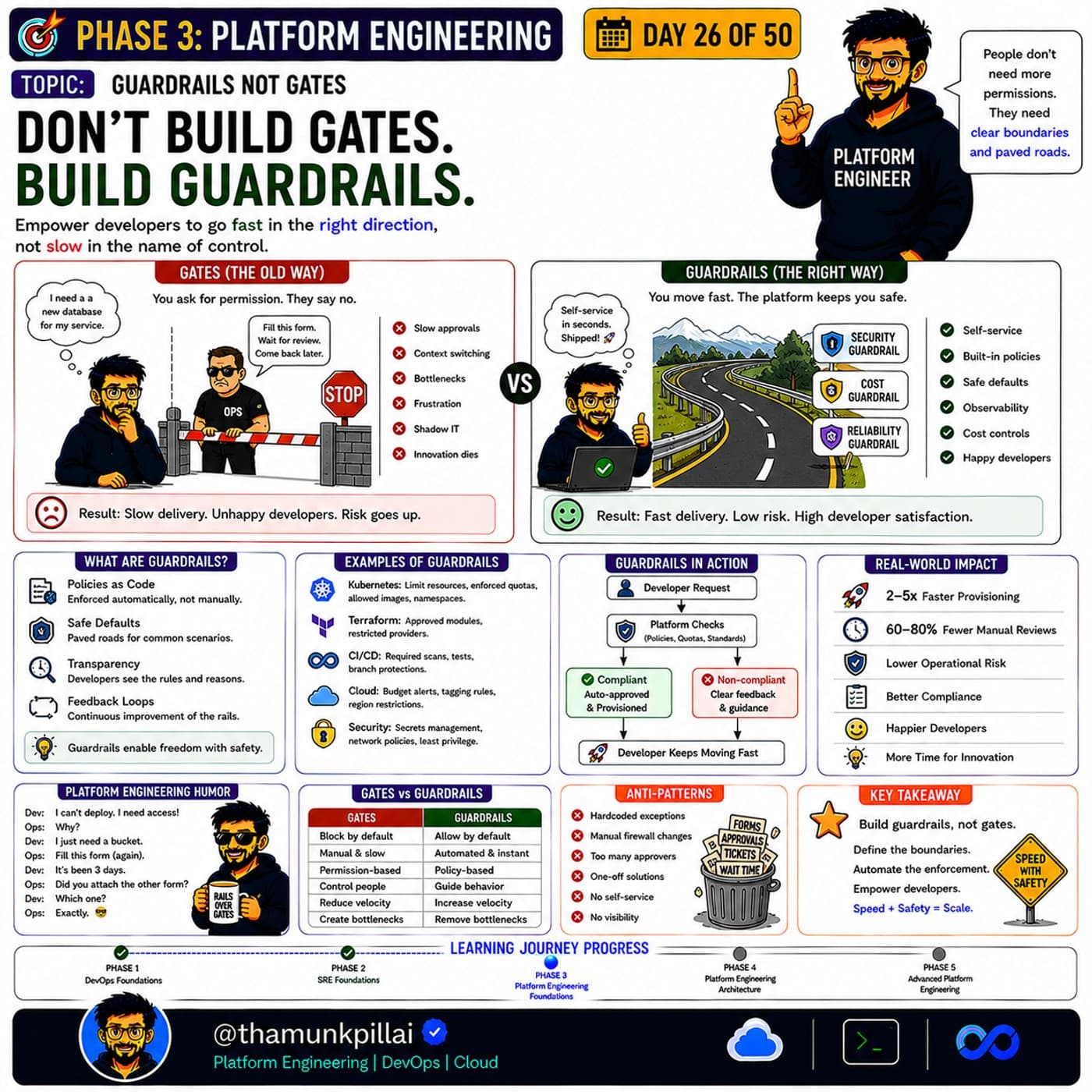
"People don't need more permissions. They need clear boundaries and paved roads." That line captures the entire argument of this article, and it's the natural next step after golden paths (yesterday) and self-service (two days ago): both of those only survive if the thing enforcing safety is a guardrail, not a gate. Get this one design decision wrong, and every improvement this phase of the series has covered quietly reverts back to a ticket queue with better branding.
A gate asks for permission before you proceed: fill out a form, wait for review, come back later. A guardrail lets you move at full speed and only intervenes at the boundary — the platform checks automatically, and either approves and provisions instantly, or blocks with a clear, specific reason and a path to fix it.
Note
The mental model that makes this concrete: a mountain road with a stop sign and a guard at every curve, versus the same road with guardrails at the edge. Both are "safety." Only one lets you actually drive at a reasonable speed.
The two models, side by side
| Gates (the old way) | Guardrails (the right way) |
|---|---|
| "I need a database" → fill this form, wait for review | "Self-service in seconds" → shipped |
| Slow approvals | Automated, instant checks |
| Context switching for both sides | No context switch — the check runs inline |
| Bottlenecks | No bottleneck — checks scale with volume automatically |
| Shadow IT | No incentive to route around the platform |
| Innovation dies under the wait | Fast delivery, low risk |
The "shadow IT" row deserves attention because it's the predictable end state of gates that stay slow for too long: developers under real delivery pressure will find a way around a bottleneck, and the way around usually has none of the governance the gate was trying to enforce. A slow gate doesn't just cost time — it actively erodes the governance it exists to protect, by pushing risk into channels nobody's watching.
What a guardrail actually looks like in practice
Developer request
      ↓
Platform checks (policy, quota, standards) — automated, seconds
      ↓
   ┌──────────────┴──────────────┐
Compliant                  Non-compliant
   ↓                              ↓
Auto-approved              Clear feedback + guidance
& provisioned               (not a rejection into silence)
   ↓                              ↓
Developer keeps moving     Developer fixes and resubmits,
                            still without a human in the loop
The right-hand branch is where most guardrail implementations quietly fail back into being gates: a rejection with no explanation, or a rejection that requires filing a ticket to appeal, has recreated the exact bottleneck the guardrail was supposed to eliminate. A real guardrail's rejection path is itself self-service — clear enough that the developer can fix the problem and resubmit without waiting on anyone.
Concrete guardrails, not an abstract concept
- Kubernetes — resource quotas, approved image allowlists, namespace boundaries enforced automatically.
- Terraform — approved module registries, restricted providers, policy checks in the plan step.
- CI/CD — required scans and tests, branch protection, nothing merges without passing checks.
- Cloud — budget alerts, mandatory tagging, region restrictions enforced at the account level.
- Security — secrets management, network policy, least privilege as the default, not an opt-in.
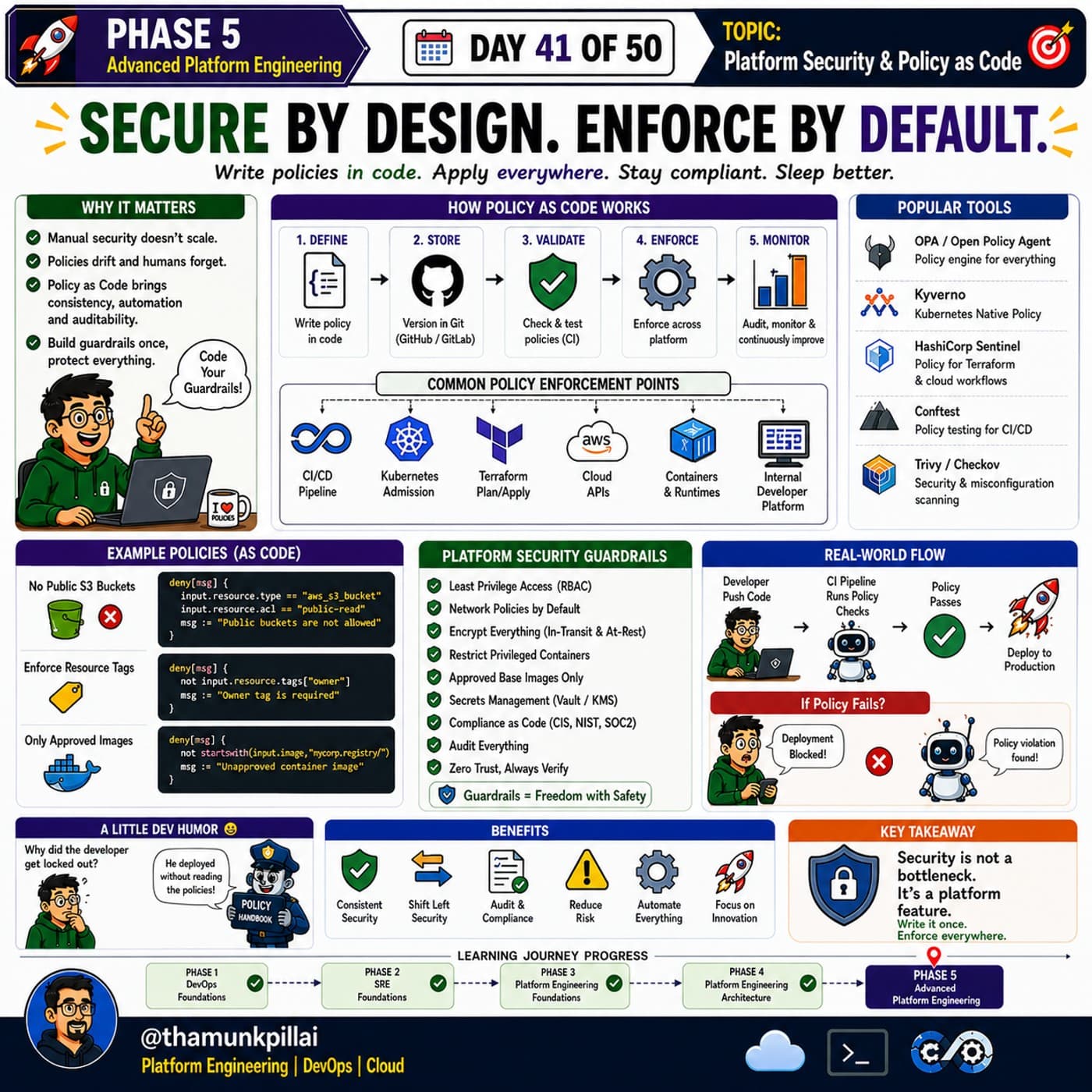
Every one of these is policy-as-code (a concept this series introduced back on Day 9): the rule lives in a file, gets reviewed like any other change, and gets enforced by automation — never by a person remembering to check.
The org-chart version of this mistake
"Dev: I need access. Ops: fill this form (again). It's been 3 days. Did you attach the other form? Which one?" is what a gate sounds like from the requester's side, and it's the exact experience guardrails are built to eliminate. If your platform's failure mode is a person waiting on a person, it's still a gate — no matter what the org chart calls the team enforcing it.
The real-world payoff, and what it closes out
The measured outcomes — 2-5x faster provisioning, 60-80% fewer manual reviews, lower operational risk, better compliance — aren't a trade against safety. They're what safety looks like when it's enforced automatically instead of manually: consistent every time, instant instead of queued, and visible to the developer instead of hidden behind a form.
This closes the loop this phase of the series has been building since Day 19: DevOps and platform engineering are different disciplines (19), platform teams exist to remove friction (20), the platform has to be run as a product (21), developer experience is how you measure whether it's working (22), cognitive load is the mechanism it's fighting (23), self-service is the delivery model (24), golden paths are the opinionated shape of what gets delivered (25), and guardrails — today — are what makes all of it safe without making any of it slow. Tomorrow's article pulls these together into the actual artifact all of this produces: the internal developer platform itself, as one coherent system rather than seven separate ideas.