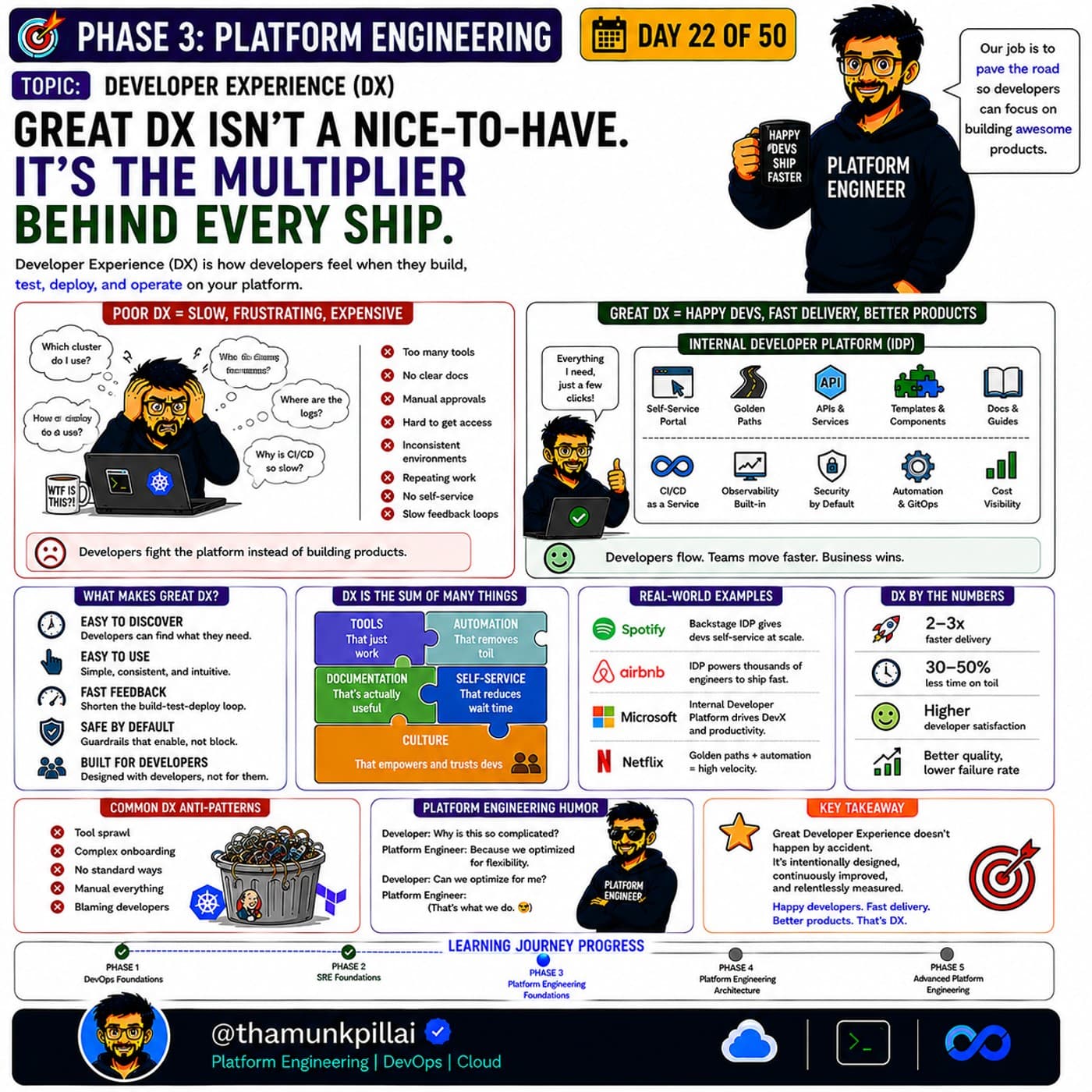
Developer experience — DX — is how developers feel when they build, test, deploy, and operate on top of whatever a platform gives them. It's not a soft, feel-good metric bolted onto engineering. It's a direct multiplier on delivery speed: the same infrastructure, wired up with confusing docs and slow feedback loops, produces a fundamentally different outcome than that same infrastructure wired up so the right path is also the easy path.
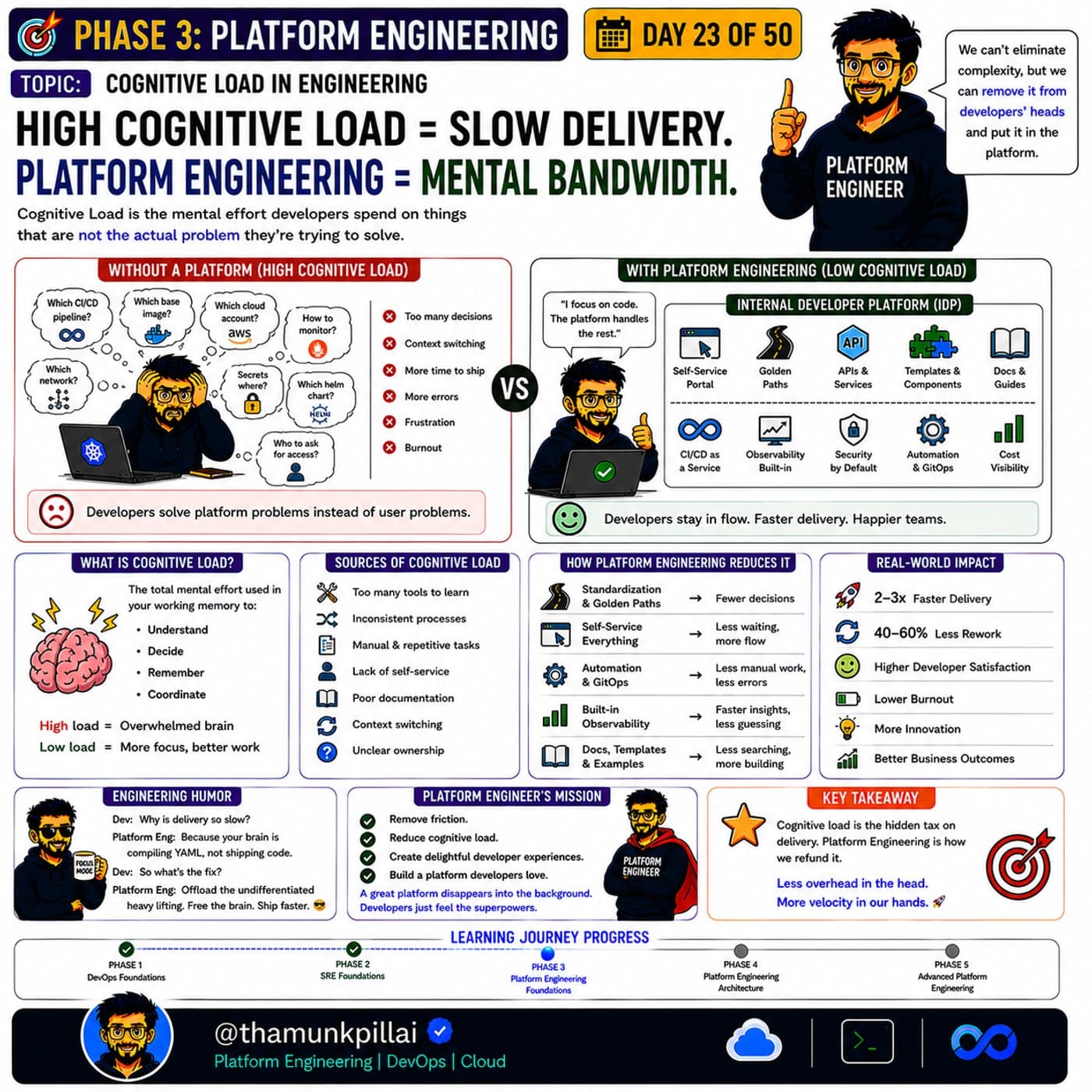
This is where the last three days of this series actually cash out. Platform engineering (Day 19) builds the thing. Treating it as a product (Day 21) means iterating on it based on real usage. DX is the lens that tells you whether any of that effort actually landed — because a platform can be architecturally excellent and still fail completely if the experience of using it is bad enough that people route around it.
What poor DX actually looks like, day to day
"Which cluster do I use?"
"How do I deploy to staging?"
"Where are the logs for this service?"
"Why is CI/CD so slow today?"
"WTF is this error even telling me?"
None of those are exotic failures — they're the ordinary, daily friction of a platform without a clear self-service path. Individually each one costs a developer a few minutes and a Slack message to someone busier than they are. Multiplied across every developer, every day, across an org of any real size, that friction becomes the dominant cost of the platform — invisible on any single day, enormous over a quarter.
| Poor DX | Great DX |
|---|---|
| Too many disconnected tools | One coherent, self-service portal |
| No clear docs | Docs that answer the actual question being asked |
| Manual approvals for routine requests | Automated, policy-backed self-service |
| Inconsistent environments | The same golden path, every time |
| Slow feedback loops | Fast CI, fast local iteration |
| Developers fight the platform | Developers flow through it |
DX is the sum of specific, fixable things
Good DX isn't a personality trait a platform team either has or doesn't — it decomposes into concrete pieces, each independently improvable:
- A self-service portal — request what you need without a ticket queue.
- Golden paths — the pre-approved, well-supported route from idea to production (this series returns to golden paths specifically on Day 25).
- An API layer and reusable templates — so common patterns don't get rebuilt from scratch per team.
- Clear docs and guides — written for the question a developer actually has, not the org chart of who owns what.
- Fast feedback — a CI pipeline in minutes, not the kind of wait that pushes developers to context-switch and lose the thread entirely.
The fastest DX win most platforms are missing
It's rarely a missing feature. It's usually documentation that doesn't answer the actual question a developer has at 3pm on a Tuesday, or a CI pipeline slow enough that people stop trusting it and start working around it. Both are cheaper to fix than almost anything else on a platform roadmap, and both have outsized effect on how the whole platform feels to use.
Why this is a multiplier, not just a comfort
The "multiplier" framing matters because DX compounds in both directions. Great DX means every developer using the platform ships faster, with less friction, which means every future feature built on the platform inherits that speed. Poor DX means every developer is quietly taxed on every task, and that tax scales with headcount — the more the org grows, the larger the aggregate cost of a platform that's technically functional but painful to use.
Note
This is the same argument this series made about toil on Day 12, applied to the platform layer instead of the operational one: friction that's individually small and constantly repeated is worse, in aggregate, than a single large one-time cost. DX debt behaves exactly like toil — it doesn't show up on a single day's timesheet, but it shows up in every retro that mentions "things just feel slow."
Real-world proof that this compounds: the platforms people actually point to with pride — Spotify's Backstage, well-run internal CI/CD at companies with genuinely fast ship cycles — aren't admired for their infrastructure choices. They're admired because using them feels good, which is DX, full stop.
Tomorrow's article looks at the cost that shows up when DX and platform design get this wrong at the individual level: cognitive load, and why the amount a single engineer has to hold in their head is one of the most under-measured constraints on how fast any team can actually move.