Yesterday's article introduced platform engineering as the discipline that builds the internal developer platform every application team relies on. Today's question is the one that comes up in nearly every conversation about it: isn't this just DevOps with a rebrand? It's a fair question, because the two disciplines share a goal — faster, more reliable software delivery — and a lot of the same vocabulary. But they solve that shared goal from opposite directions, and the difference isn't cosmetic.
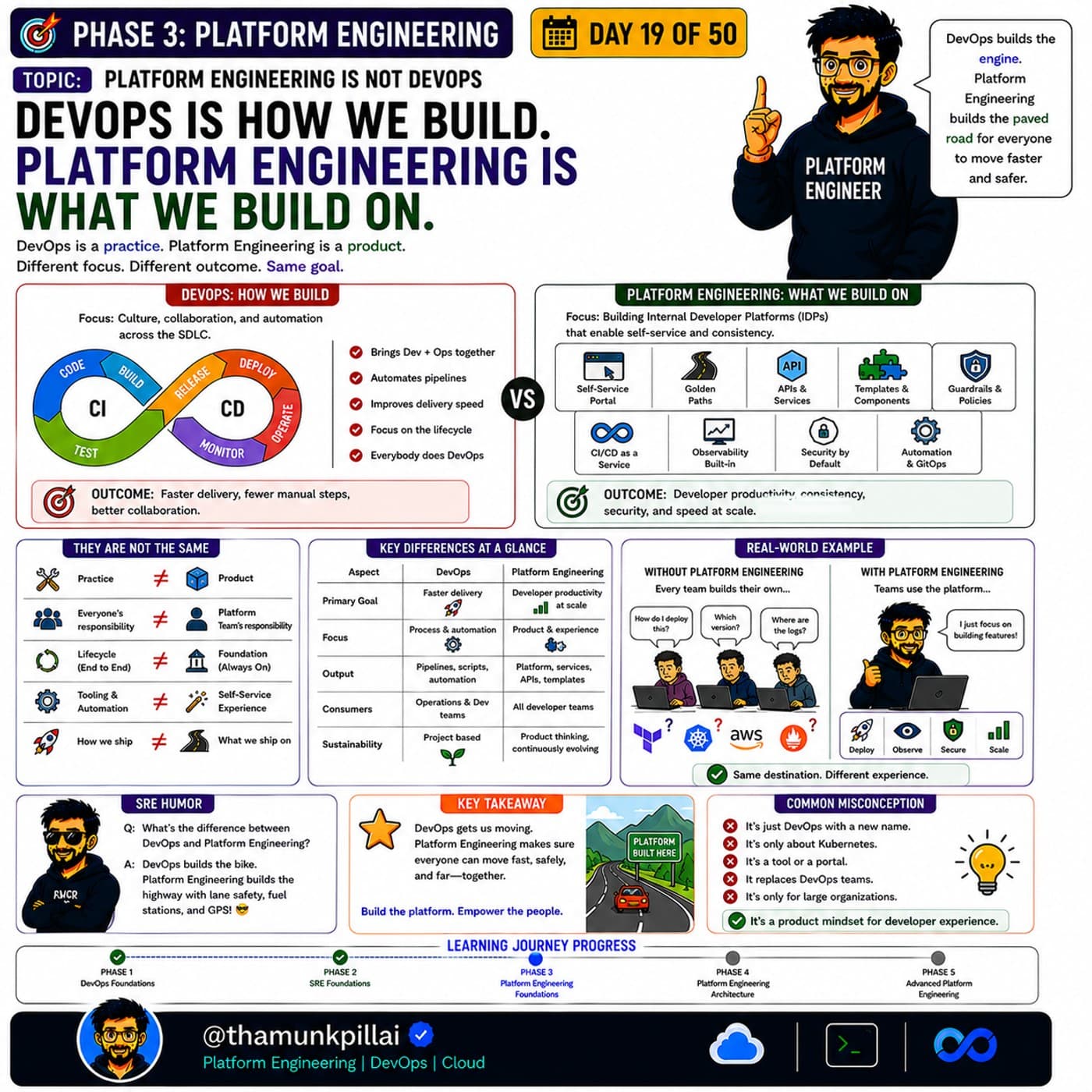
DevOps is a practice: culture, collaboration, and automation applied across the whole software lifecycle, by everyone, everywhere. It's the discipline this entire series opened with — breaking down silos (Day 3), automating instead of relying on heroics (Day 4), treating infrastructure as code (Days 5–9). Nobody owns DevOps. It's everyone's job.
Platform engineering is a product. It has actual users — your developers — and it ships an actual artifact: the internal developer platform (IDP). Unlike DevOps, someone does own it, and that ownership comes with product responsibilities: a roadmap, adoption metrics, user feedback, and the very real possibility of building something nobody uses.
Note
The cleanest way to hold the distinction: DevOps is the engine. Platform engineering builds the paved road so every team can drive that engine faster and more safely, without each team having to build their own road from scratch first.
Same lifecycle, different focus
| DevOps | Platform Engineering | |
|---|---|---|
| What it is | Culture, collaboration, automation | A self-service product (the IDP) |
| Who does it | Everyone, across the SDLC | A dedicated platform team |
| Primary goal | Faster delivery, shared ownership | Developer productivity at scale |
| Outcome | Brings Dev and Ops together | Self-service, golden paths, built-in guardrails |
| Failure mode | Culture doesn't stick, silos re-form | Low adoption — teams route around the platform |
Both rows on "failure mode" matter, but the platform engineering one is worth sitting with, because it's the one people underestimate. DevOps failing looks like old habits creeping back — annoying, but rarely catastrophic on its own. Platform engineering failing looks like a team spending two years and real budget building an internal developer portal that developers quietly avoid because it's slower than what they'd hand-roll themselves. That's not a culture problem. It's a product failure, with all the same causes a customer-facing product failure has: nobody talked to the users, the roadmap chased what was technically interesting instead of what was blocking people, or it shipped once and never iterated.
Why this distinction changes how you'd actually run each one
If DevOps is a practice, you invest in it by changing how teams work — shared on-call, blameless postmortems, automation as a norm. There's no single artifact to point at and no adoption curve to track, because it's not something teams opt into using; it's how they operate.
If platform engineering is a product, you run it the way any good product team runs anything: user interviews with the developers who'll use it, adoption and satisfaction metrics tracked over time, a roadmap that's willing to be told a feature isn't wanted. That's a materially different set of skills and a different kind of team than "the people who used to be called Ops."
The tell that separates the two in practice
DevOps done well is invisible — it's just how the team operates, and nobody talks about it as a separate thing. Platform engineering done well is visible: developers can point at the portal, the golden path, the docs, and say "that's what lets me move fast." If your platform can't be pointed at, it might not exist yet — or it might just be DevOps wearing a new name.
Why this series treats them as sequential, not interchangeable
The first nine days of this series were DevOps and infrastructure-as-code — the cultural and technical groundwork. The next eight were SRE — the reliability discipline that makes systems trustworthy once they're running. Platform engineering, starting yesterday and continuing for the next several weeks, is what happens when an organization has enough teams independently doing DevOps and SRE well that someone finally asks: why is every team solving the same infrastructure problems from scratch? The answer isn't "make everyone even better at DevOps." It's building the product that lets teams inherit those practices by default, instead of reinventing them. Tomorrow's article gets specific about exactly what problem that product is solving.